

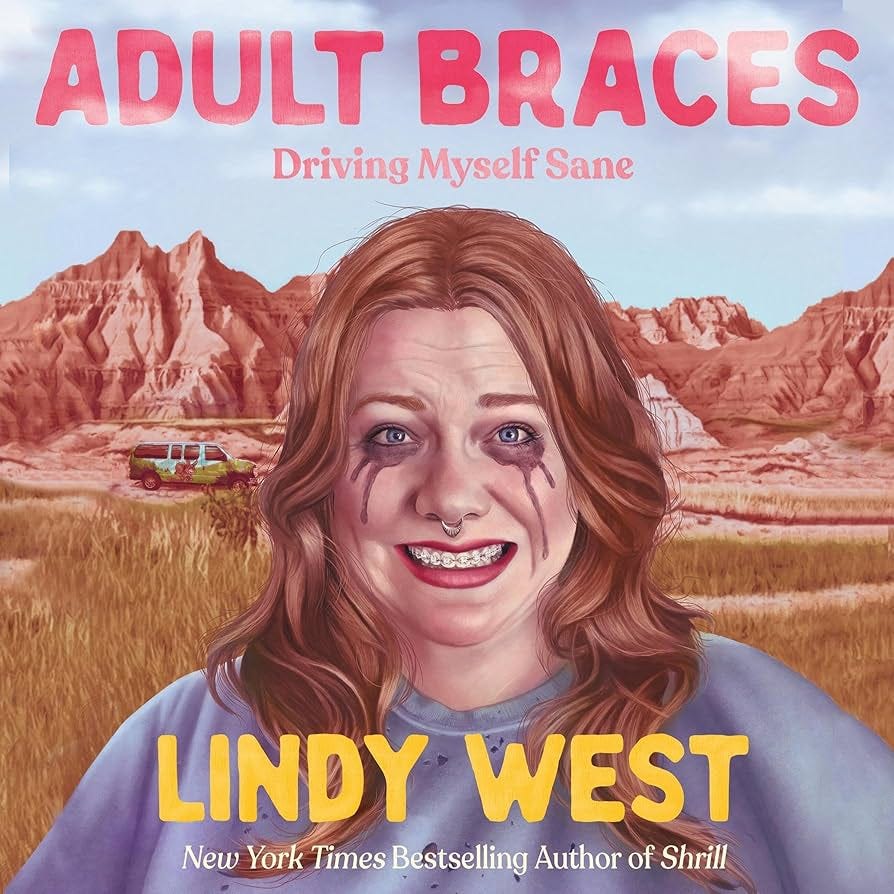
The internet’s main character this week is writer Lindy West, whose new memoir Adult Braces is about being coerced into a polyamorous relationship by a chaotic partner but then going on a journey of personal discovery (solo US road trip) and finding that, actually, being in a romantic triad with her husband and his girlfriend works surprisingly well and makes her pretty happy. She did an interview with the New York Times that went quickly viral, mostly because her relationship did not, in fact, come across as particularly happy, fulfilling, or personally empowering. That piece is worth a read if you haven’t seen it yet.
There are obviously more than a few red flags waving in West’s telling of her relationship(s); her husband very much does not seem on the level, to put it mildly. But it’s also the case that none of us are inside of West’s marriage, and none of us — not even West — see the whole picture. I should also say here that I am a Lindy West fan: I think she’s funny and perceptive, I think her work very much changed American culture for the better, and I always read her with delight and respect. I can also imagine just how invasive and destabilizing it must feel to have the internet opining on your marriage and intimate choices, even if you have chosen to put the story of your marriage and intimate choices in the public square, and even if you have been — as Lindy has been, as I have been — a person who has for decades publicly criticized the semi-private lives of public figures, because the personal is political and so on. I think there is good reason to criticize men who dress up their desires for non-monogamy in the language of feminist anti-racist progressivism, when it’s really just about getting women to do stuff those women really don’t seem like they want to do. I think the feminist movement is long overdue for a critique of the “consent” model of sex and relationships, where ethical boundaries are not drawn according to any moral code beyond request and permission. I think we’re even longer overdue for questioning whether agency and personal choice are useful frameworks for analyzing the interpersonal relationships molded by sex and sexism.
But also: The villain / victim narrative seems far too simple here. We don’t have to believe that West’s claims of personal happiness are objectively and permanently true to see that they are the story of her life right now — and what more do we really know?
And so I have very little interest in (publicly) psychoanalyzing West or opining on polyamory or her relationship; you can find plenty of that elsewhere. West is a person, not an internet figure to be picked apart. Like I said, I like and respect her; I’m troubled by the treatment of her as more character than human, an avatar for something else (the failures of 2010s feminism?). Much of the conversation just feels mean, and I feel for her in this moment.
I’m more interested in the stories we tell about our lives: the pressure to package our lows into a narrative of past pain transcended by personal and emotional leveling-up; the difficulty and freedom in realizing we’re often in the good parts and the hard parts all at once. I’m interested in the truth that there is no single truth — that the story of all of our lives is less in what actually happened than in the writing and re-writing.
In this, I think West’s memoir may wind up more useful in hindsight than in the moment: I am curious to see how this story gets re-written in later years. This memoir comes nearly a decade after West’s runaway hit Shrill, which is all about her rejection of the male gaze, her work to feel confident in a larger body, and her repudiation of traditional stories about how women should be and how women’s bodies should look. In Adult Braces, we learn that the confidence infusing Shrill wasn’t quite so unshakeable. Getting together with Aham, her now-husband, felt affirming in part because West had bought into the story that bigger women would never draw in attractive men men; marrying Aham in a big celebratory wedding felt affirming because the brides we see in magazine spreads of big celebratory weddings are usually skinny. Through it all, though, West never doubted that she deserved life-changing love.
The truth, in West’s telling now, is that insecurity plagued her relationship, and that she clung tightly to Aham even when she was being manipulated and profoundly emotionally neglected in part because of her fears that no one else would love her. Adult Braces is an edit to the Lindy we meet in Shrill, whose insecurities had been conquered.
And of course it is. The stories we tell about ourselves always evolve. We shift and change, but we are rarely so fully reborn as to permanently escape old habits and forget old beliefs. The difference is that most of us don’t commit a version of our previous selves to paper the public can buy on Amazon.
Elizabeth Gilbert is another memoirist I like, whose own narratives have also proven less permanent than the ink they’re printed on. Her breakthrough hit was Eat, Pray, Love, which begins with her escaping a dysfunctional marriage to eat her way through Italy, meditate her way through India, and eventually find herself in Bali — and ends with her meeting a Brazilian hottie who she subsequently marries to the tune of Harvest Moon. First-chapter Elizabeth is impulsive, love-chasing, emotionally strung out. End-of-book Elizabeth is fully realized, contented, in balance.
Except, of course, she wasn’t. That marriage ended, too; she fell in love with her best friend who was dying of cancer, and “dysfunctional” doesn’t even begin to do their relationship justice (there were benders and relapses and so many drugs and eventually Gilbert tries to murder her dying girlfriend). And then, on the other side (and printed on the pages of a new book), a new narrative, one about the dissonance between her private life and her public one; sobriety and a 12-step program for sex addiction; a Botox-free face and the shaved head of a monk.
I once was lost, but now I’m found — these are the stories we hear. They’re the stories we tell, and tell again. They’re usually true, even when, later, we realize we were lying.
I actually think there’s something quite beautiful about this. The human capacity to change, and also to believe we’ve changed perhaps more profoundly than we have, is part of what makes us good, or at least interesting.
I just wish there wasn’t the pressure — culturally, in the publishing world, in our own minds — to wrap our stories up with a neat and satisfying conclusion. I wish I once was lost, I am still wandering was an ok place to be, an ending a reader might accept.
I am fresh off of a week of teaching a writing retreat in Kenya, and in my writing classes, there are always questions not just of how to end a story, but when to tell a story. Does the story need resolution? Do you need space from difficult events before writing about them? How far away do we have to be in order to share a story’s truest telling? I often use the example of your first big relationship and first really painful breakup: The story of that relationship will be very different five minutes after the breakup, five weeks after the breakup, and five years after the breakup. The events won’t change, but you will. Your memory of them will. Your story of what they mean will. All of those stories will be true, even if they conflict.
One question is how your write that story. Another question is when you write it.
Some of the pieces I’m reading about West suggest that perhaps she shouldn’t have written this book, at least not now, because she is still in the middle of this story. And that critique seems fair, not just to protect her audience, but to protect her: The stories we tell are powerful, and when we tell them to the world, we may also commit to them more deeply, and that might actually be bad for us. They may suggest to readers that maladaptive behaviors are find and normal, which is bad for society.
But also: We rarely truly find absolution. The end of the story is almost never really the end. So what if we write in the middle?
Committing your story to a journal is of course a different thing than publishing it, which suggests some lesson not just learned but worth sharing with a broader audience. Criticizing the relationship of someone who chooses to publish a memoir about their relationship is fair game. But better questions might be: Why are we so hungry for resolution and a happier-by-the-end narrator? Would we be better at processing and understanding our own individual stories if our cultural storytellers weren’t so pressured to write resolution where there may be none, and to claim personal evolution when reality feels more like churning?
Wouldn’t it be more interesting, and certainly more honest, if we resisted the urge for a neat narrative arc that concludes with our hero walking into the sunshine and admitted, instead, that sometimes we’re writing from inside the dark of the woods?
xx Jill
I’m in my 60s now and I am so so very weary of this recurring narrative that being masochistic or submissive or accepting a cheating partner is somehow empowering for women if they “consent” to it. I’m so tired of the societal pressure put on girls and women to grant that “consent” or be stigmatized as a stick in the mud. Back in the 80s when I was in college my Mom said it seemed to her that the minute we gave girls permission to say yes, we withdrew their permission to say no. I’m tired of being told I’m a prude or closed minded or a killjoy for not finding 50 Shades or Babygirl sexy or Sabrina Carpenter’s controversial album cover “cheeky and fun!” and for insisting that for an adult relationship to be genuinely good and healthy and empowering it needs to be a partnership of equals who respect and care for one another. Somehow, no one ever tries to sell us the story with the roles reversed as being sexy or romantic or empowering for the man.
Such a nuanced and compassionate but also genuinely interrogative piece about *that* interview, the book, and narrativizing/intellectualizing incredibly raw periods of intensely private interpersonal exploration (or perhaps even coercion), for public consumption in the form of memoir.
Specific to West, who I also LOVE, this struck me: "I think there is good reason to criticize men who dress up their desires for non-monogamy in the language of feminist anti-racist progressivism, when it’s really just about getting women to do stuff those women really don’t seem like they want to do."....!!!!!!!!!!!!!!!!!!!!