

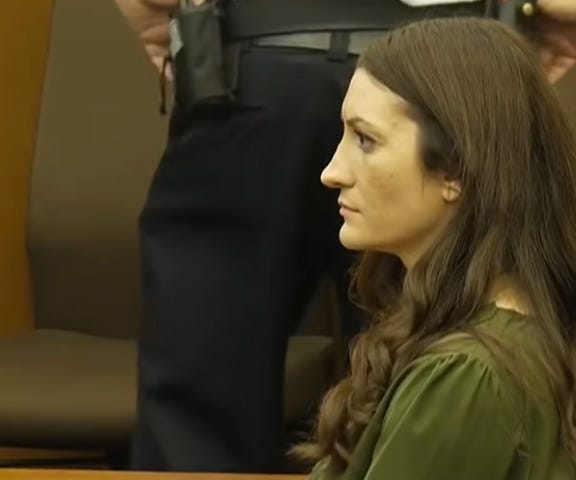
I’ve been avoiding writing about Lindsay Clancy.
I started following the case fairly early on, after reading a remarkable story in the New Yorker about Lindsay’s husband, Patrick, who has lived through an unthinkable nightmare — his (now ex) wife killing their three children, then trying to kill herself — and has somehow managed to live and even forgive his former spouse. Now, Lindsay Clancy is on trial. The state of Massachusetts says she killed her children on purpose, planning the crime because she was tired of her boring suburban life. Clancy’s team says she was in a state of psychosis, pointing to the fact that the killings occurred after months and months of Clancy seeking help: Going to therapists and psychiatrists, being put on different cocktails of drugs, trying (twice) to be admitted to a mother-baby psychiatric unit, and over and over again not getting the care she needed. Now, she seeks to be declared not guilty by reasons of insanity, which would put her in a mental institution instead of prison.
The Clancy case is devastating. I have not watched the trial in part because the prosecution has focused on detailing the murders, and I just… cannot. Cannot listen to that, cannot think too deeply about it. And apparently neither can Lindsay Clancy: When the prosecutor was describing the killings in detail, she sobbed inconsolably, and it was so jarring that the judge had to call a break so that she could gather herself.
The most interesting thing to me about the Clancy trial, though — and to the scores of people watching it — is the reaction from women. I wrote about that and the trial for the New Statesman, about how this strikes me as something of a #MeToo moment: A collective outpouring of anger and grief long held in fear and silence. Postpartum psychosis is rare, but huge postpartum emotional swings, stressors, hormonal plunges, depression, and despair are not. Most of the mothers I know may not have had psychotic incidents, but have felt, as I wrote in the New Statesman, an “intensity of emotion that it simply blacked out all rational thought, made me feel feral and divorced from my own mind” — that let me see “just how fragile my own tether to reality could become.” This can be all the more intense in a place like the US, where mothers are left largely to fend for themselves.
Women have rallied around Lindsay Clancy, not in defense of her horrific act, but against throwing her in prison — in support of seeing her as a victim, too, and as someone who never in a million years wanted this to happen. That so many women relate to her should tell us something profoundly troubling about the American system of childrearing: There are a lot of women who have been so far out at the end of their ropes that they can relate to a mother who, in a fit of psychosis, killed her children. This is a collective scream for help.
There are of course some who are taking it past the “I can relate to the unexpected intensity of emotion and despair” and into the bizarre and parasocial. These women have gone viral for justifying Clancy’s acts, or downplaying Clancy’s acts, or arguing that Clancy didn’t act at all — there is a whole True-Crime-brained subgenre of social media posters who insist it was Patrick who killed the kids and framed Lindsay. These unhinged accounts have drawn a lot of attention. But they aren’t all that representative of what women are posting about Clancy — or, more importantly, what women are discussing amongst ourselves.
My dear friend Jess Mack described the trial as “haunting me and every mother I know.” That very apt word — haunting — has been turning over in my head since I read Jess’s piece. Motherhood, she writes, opens up “magic trapped doors of empathy and capacity. But the unsettling thing we know deep down is that our seemingly endless capacity to hold it all is not without cost somehow, somewhere down the line.”
The Clancy case is, again, about postpartum psychosis, not simply overwhelm or even postpartum depression. As far as I can tell, Clancy is not a mother who was simply pushed to her limit and cracked — she was a mother whose brain was literally malfunctioning, and who was also pushed to her limit, and was also neglected and ill-treated by those who should have helped her. But there is also much we don’t understand about postpartum psychosis (we don’t understand practically everything about it). One thing that is clear is that leaving women who are experiencing it without loads of support virtually guarantees that they will crumble down — and in the worst, rarest cases, that tragedy compounds.
I’ve been seeing posts from right-wing men arguing that women who feel for Lindsay Clancy are dangerous, that these women are bad, evil, child-hating mothers. I actually hear women saying that we love our children in the words of every cliche and then some — more than life itself, more than anything, more than I ever could have imagined — and there must have been something seriously, profoundly wrong for a mother like Lindsay Clancy (a mother like us) to have done anything to hurt them. Most of us, I would imagine, have never been tempted to harm our children. But most of us have been pushed beyond what was emotionally familiar or even possible — into a galaxy of unimaginable love, but also into an abyss of fear, anxiety, and despair. The aim is not to say “Me too, Lindsay” (I, least, don’t feel like I personally relate to Lindsay Clancy). The aim is to protect children and to support the mothers who bear and raise them — to say that mothers are criminally neglected, and when we do that at scale, tragedy follows.
The one piece of good here is that we have made some progress. In 2001, Andrea Yates drowned her five children in a bathtub, and while some women spoke out for her, she was widely seen as a horrible child-killer. In reality, her husband Rusty was an Evangelical Christian who believed it was his duty to have as many children as possible. Yates had multiple breakdowns in her postpartum periods. She begged Rusty to kill her. She was diagnosed with postpartum psychosis. She mutilated herself. She was hospitalized in a psychiatric facility, at which point one of her doctors told Rusty in no uncertain terms that another pregnancy would trigger another psychotic episode, and that she could not have any more babies. He impregnated her a few weeks later.
The understanding of postpartum mental illness is much more sophisticated today than it was 25 years ago. The response to the Clancy trial is very different than the response to Yates.
Still, I am haunted by the Clancy case. I feel sick when I think of Cora, Dawson, and Callan, the Clancy children whose lives were ended by the person they trusted most in the world. I feel sick when I listen to the prosecutor suggest that Lindsay Clancy was simply tired of being a suburban mom, and when that same prosecutor seems to relish in recanting the most horrific details of Clancy’s crime. I am shaken by the many, many women who look at Clancy and see some magnified image of themselves — and mostly just disappointed in a whole society that professes to protect children while not doing a damn thing to help their mothers.
xx Jill
American motherhood can be so isolating. For most of history, children were reared in much more communal environments within tribes, clans, and extended family groups - that "village" Hillary Clinton was ridiculed for invoking. The stand-alone nuclear family is just so precarious, particularly in a country with very little in the way of safety net.
Great piece, Jill.