

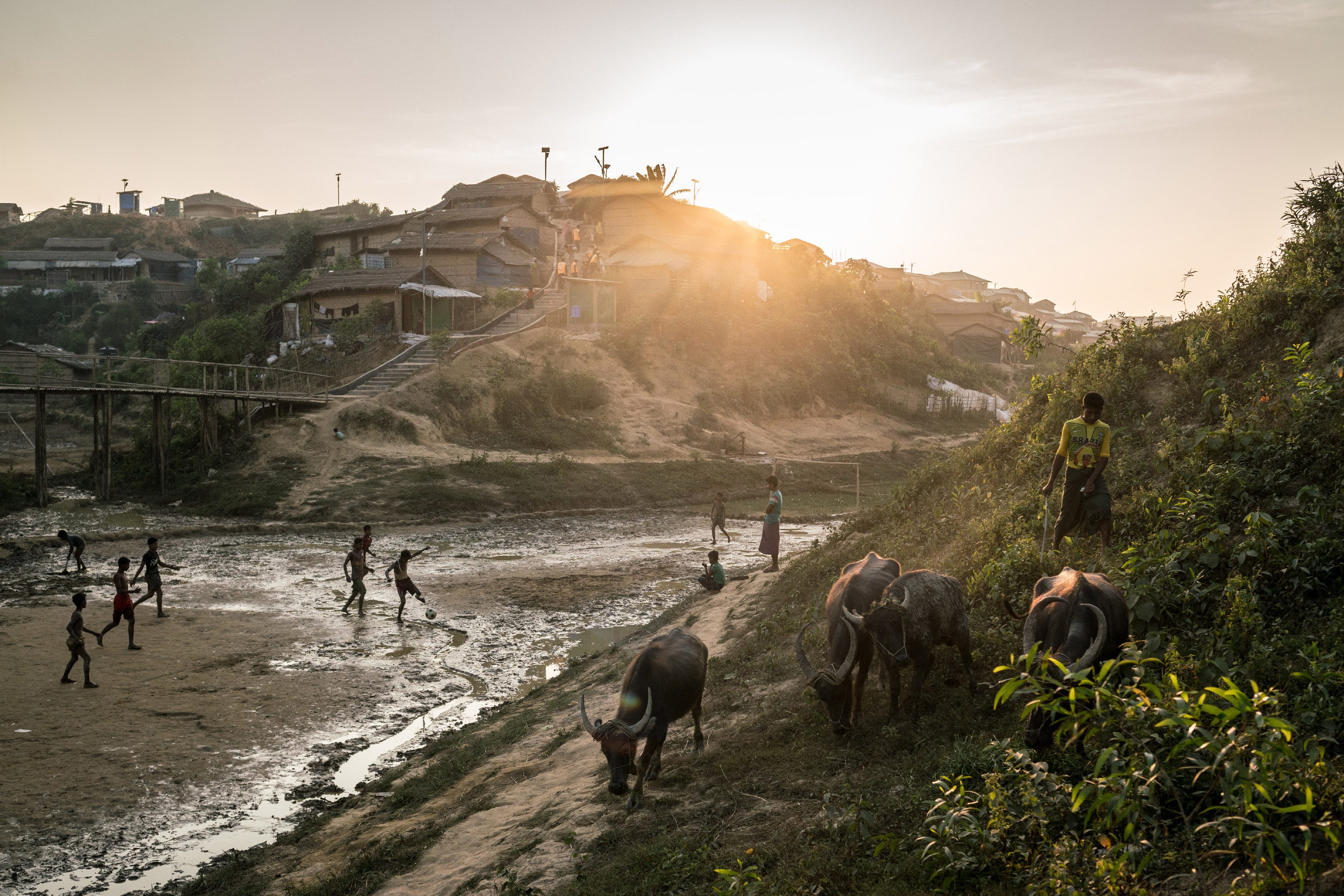
A Rohingya refugee camp outside of Cox’s Bazar, Bangladesh, in 2018. Photo by Nichole Sobecki, VII.
What I remember most is a hand.
The fingernails were seared off, fingertips melted down like candles left to burn too long. The hand was tiny, belonging to a little girl named Ayesha, who had a cheeky smile and mournful eyes. She was born in Rakine State in Myanmar, into a Rohingya family — a minority Muslim group often persecuted by the country’s Buddhist majority. Her family had grown accustomed to dealing with the usual troubles: Family size limits imposed by the state; harassment from cops and soldiers; sporadic and seemingly random violence. But the night the Rakine mobs burned their village – no one saw that coming.
The wooden homes in the village went up in giant pyres. Soldiers and other assailants seemed to attack with both impunity and specificity. Men had their throats slit, and were thrown into the flames; that’s what happened to Ayesha’s dad. Women were gang-raped. Children who cried were thrown into the fires, too. Ayesha cried.
Ayesha was lucky, though – she was six, old enough to walk and to run (the babies who cried, who were ripped from their mothers’ arms, were not). She landed on the side of the fire, and was able to roll out and run away.
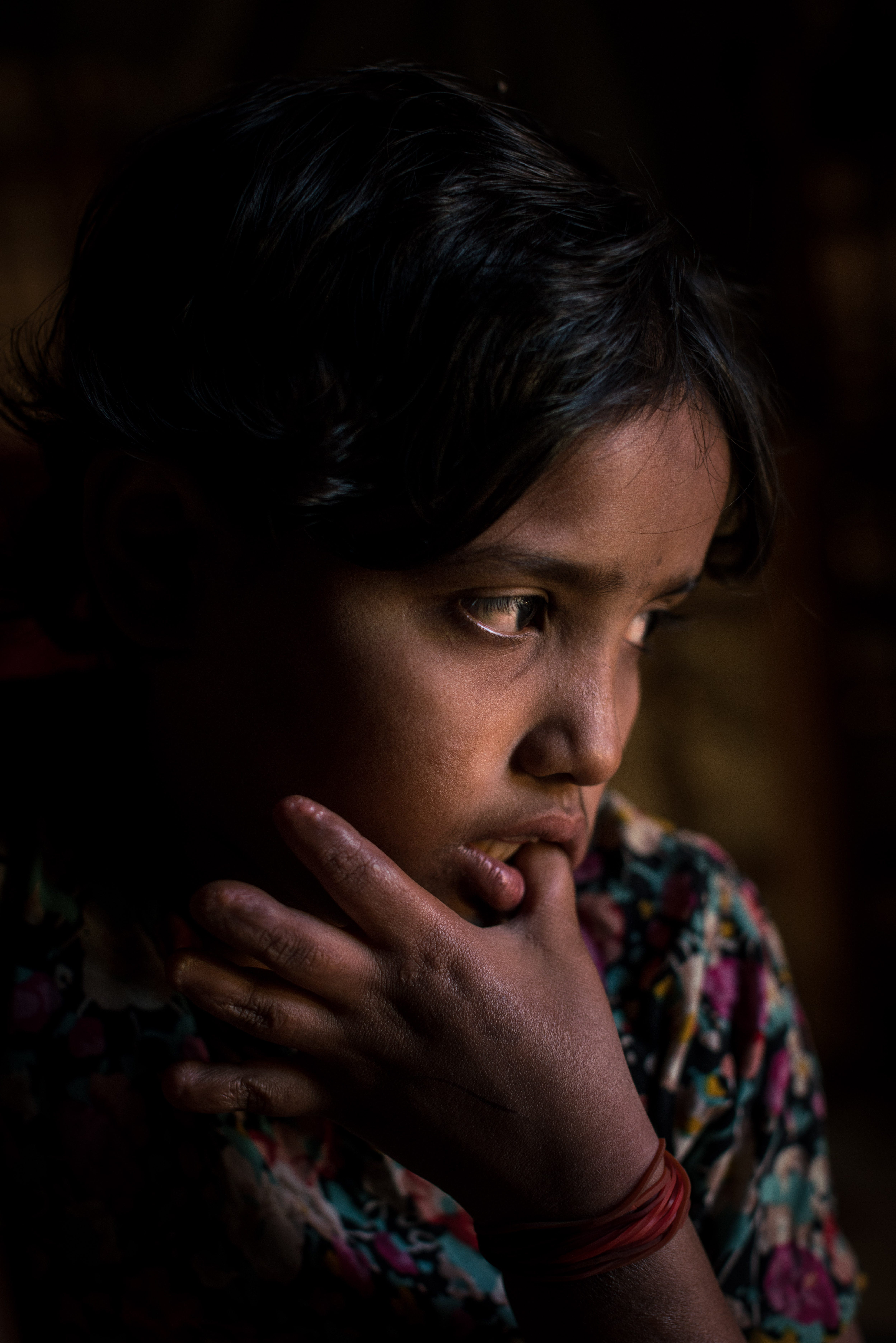
Ayesha’s mother, Fatimah, managed to gather her six children and spirited them into the woods, where they walked for days. The littlest one, Hasina, was just a toddler, and she was badly dehydrated and fatigued; Fatimah worried she would die. But there was nowhere to go but onward. They reached the water, and got on a boat teeming with other Rohingya, all as desperate and hungry and wild-eyed with fear as Fatimah’s children were, and sailed to Bangladesh. They made it. Others didn’t, and for weeks, corpses bobbed in the water. Roughly three-quarters of a million Rohingya fled Bangladesh in just a few weeks, the largest mass exodus in modern history. By the time I met Ayesha, she was living with her family in a refugee camp outside of the Bangladeshi beach resort town of Cox’s Bazar, in a tarp-roof hut Fatimah built with her own hands. I was there a year after the exodus, traveling with photographer Nichole Sobecki to tell the story of why women raped in conflict so often cannot get safe abortions. By the time we arrived, there were more than a million Rohingya in the Cox’s Bazar camps.
Today, the International Court of Justice found Myanmar responsible for genocide against the Rohingya people. The ICJ heard evidence that the Myanmar military intentionally targeted men, women, and children simply because they were Rohingya Muslims – and that the government’s claims of enforcing security and counterinsurgency measures were belied by the fact that soldiers raped women, torched villages, and killed children and babies. Soldiers who had defected told investigators that their commanding officers instructed them to exterminate the Rohingya. “Today, we have finally been heard, and it is a profound relief,” one Rohingya survivor told the Guardian. “This judgment gives hope to our children and the next generation of Rohingya. But our fight is not over.”
I was in Bangladesh in 2018. New York Times Southeast Asia Correspondent Hannah Beech is there now, reporting on this verdict. In the nine years since the genocide, life in the camps has gotten worse. Here’s what she’s seeing:
The monsoons bring floods and landslides, the dry season fires that torch the bamboo spines of the shelters. With international assistance drying up, the Rohingya have grown even more precarious. Before, each person received $12 in food aid. That was per month, not per day. Now, because of international funding shortfalls, the monthly stipend has dropped to $10.
I spoke to people who said they hadn’t tasted red meat in years. One man closed his eyes as he recalled the taste of his favorite beef curry.
After President Trump returned to office, Rohingya who were poised to receive refugee status in the United States were abruptly told they were no longer welcome.
Running gun battles between rival militant groups bring terror to the cramped camps. Mothers try to keep their children at home, particularly teenage girls and boys, for fear that they will be kidnapped and forced into sexual slavery or conscripted to fight. As I walked through the camps on Wednesday, the day before the International Court of Justice verdict, two fresh-faced militants sauntered past me, with pistols at their hips.
The photos and videos accompanying Beech’s dispatches are all of men gathered to hear the verdict, men celebrating. That is not a coincidence. The Rohingya community is by far the most conservative I’ve ever reported in. Girls marry as teenagers, and then are discouraged from even leaving the house. A refugee camp, where homes are small and much of life happens in public view, is a shock; women really only go outside in the camp if they’re fully covered in a burka, and even that is borne of necessity — many men were killed, and so many women are trying to keep their remaining families alive on their own, and that means going out in public, even if going out in public is another indignity layered onto so many debasements. Sexual violence in any conflict, or any context, is horrific. The sexual violence that was endemic in the Rohingya genocide brings with it extra levels of shame and isolation — a woman who is known to have been raped is tarnished, damaged; her daughters are tarnished, damaged, may never marry. A woman who never marries has no way of making an income, is not warmly welcomed into the community, is totally alone in the world.
After I talked with Ayesha and Fatimah, Nichole asked if she could take some photos, Fatimah pulled Ayesha over, grabbed her hand, showed Nichole where tiny fingernails should have been. She pulled up Ayesha’s shirt, showed Nichole her back, creased and creped like papier mâché. Look, she pleaded.
I don’t know where Ayesha, Fatimah, and the rest of their family are now – but I would guess they’re still in Cox’s Bazar. I don’t know what this ruling means for them, or what it means for the scores of women whose lives and futures, and whose daughters lives and futures, disappeared in a night. I hope it means something. I hope, at least, that Fatimah feels like someone finally saw.
xx Jill
Thanks for telling this story. To think we let Trump and his merry band of ignoramuses dismantle the U.S. Agency for Internet Development! Trump and co. oppose the ICJ as well.
Thank you for this very touching and tragic report. I will never understand man's in humanity against each other. Your compassion shed light on this tragedy. The very women who give birth to us seem to be targets of our worst fears and violence. What is it about human nature that is so inhuman. Thank heavens that goodness still lives like embers in most human hearts.