


According to new Gallup polling, young men are more religious than they’ve been in 25 years. Women across the board are less religious than they’ve ever been, and young women are the least religious group in the country. The religiosity gap between young women and young men is now nearly as wide as that between women and men over 65 — except among the young, it’s men who are much more likely to say religion is very important to them, while among the old, it’s women who are the religious ones. The changes in young men’s religiosity come almost entirely from Republican men.
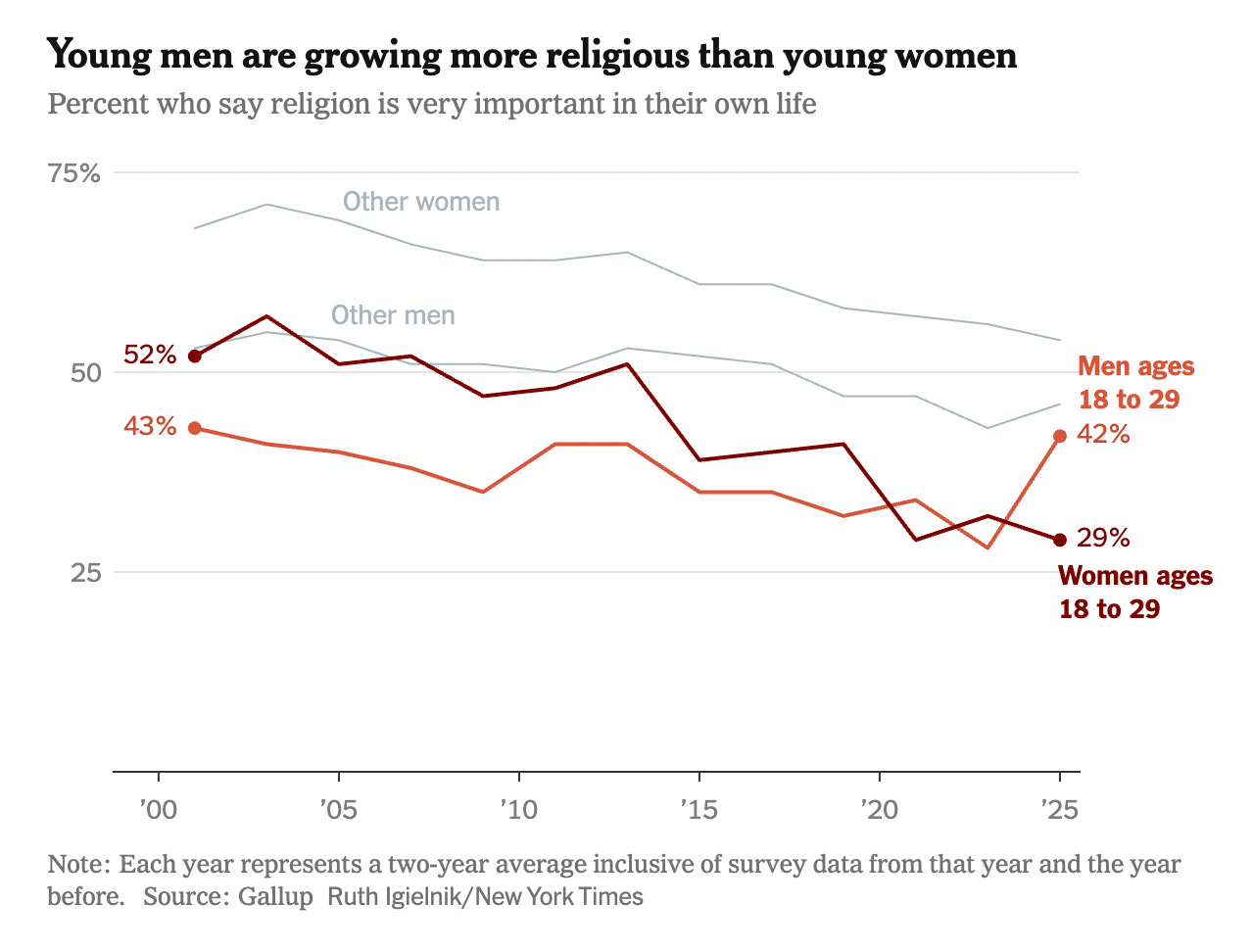
I’m not convinced that this shows some widespread return to religion. But I do think it is further evidence of a significant divide in worldview between young men and young women — and perhaps indicative of conservative young men looking for institutions that will help them make meaning of their lives, and affirm their desire for respect, adulthood, and authority.
What are the meaning-making institutions in American life? That is, where can people gather and not only connect socially, but find some lessons and moral frameworks to help them make sense of the world around them, and find pathways to community approval and the pursuit of something bigger than themselves?
This is what religious institutions have long offered. But they began to face competition. Colleges and universities were once not just about teaching young people to be competent workers, but about imbuing young people with the knowledge that would expand their minds, help them be good citizens, challenge their intellectual capacities, and set them on course to build lives of purpose — that’s the basis of a liberal arts education. There are certainly many educational institutions that still do that important work, but they seem fewer and farther between as standards have lowered, grades have inflated, and college is increasingly seen as a credentialing entity for a lucrative profession rather than a training ground for the curious and expansive minds of citizens in a participatory democracy.
Campus activism is one place where students have found a sense of purpose, and so I read with some interest this piece that asks why young people are not protesting en masse against Donald Trump and the Iran war on college campuses (or off of them). The author, Thomas Edsall, and the experts he interviews argue that it’s because “powerful technological forces weakening persistence and cognitive tenacity across the board” — the kids are speed-scrolling through so many TikTok videos they’ve lost their capacities to do difficult and sustained tasks, like participating in organized protest movements.
I am convinced that our phones have made us less focused and more apathetic, but the duration and intensity of the Gaza protests on campuses undermines the “phones = no more protests” theory. The causes are many, but I think it’s clear that legitimate fear of Trump administration crackdowns and the wind-down of the worst of the war in Gaza have kept a lid on post-2024 Gaza-related protesting. That doesn’t fully explain why there aren’t student protests against Trump himself or his and Israel’s Iran war. My personal theory there is that it’s not as fun and countercultural for college students to protest Trump and Republicans. Overwhelmingly left-leaning college kids protesting Democrats is kind of like getting mad at your mom: The resentments might be real, but the stakes are low. And the protests were fundamentally social, meaning-making events in which opposing Democrats from the left was part of the collective identity; hating Trump isn’t particularly edgy.
Some people who clearly have found purpose in protest are middle-aged highly-educated liberal women, who over the past decade have turned out in enormous numbers for the Women’s March, Black Lives Matter rallies, anti-ICE demonstrations, and most recently national No Kings protests. Far-left and far-right podcasters and social media opiners may have found common cause in deriding these women (“MSNBC moms,” “middle-aged wine moms,” “AWFULs - Affluent White Female Urban Liberals,” pick your insult), but they are among the most powerful forces in American political life, even if their politics are currently sidelined.
These are also women with a lot of practice in purpose-finding and meaning-making.
