

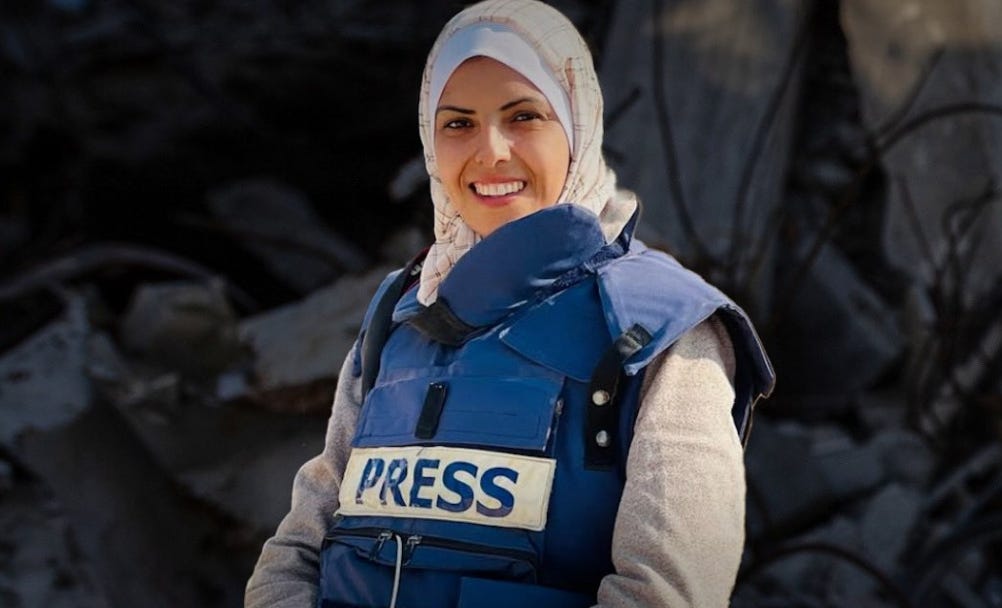
Mariam Dagga, a visual journalist for the AP who was killed in Gaza on Monday
On Monday, an Israeli strike killed five journalists at a hospital in southern Gaza, including freelancers for Reuters and the AP, along with civilians and health workers. According to the Committee to Protect Journalists, nearly 200 journalists have been killed in the Israel-Gaza war so far. The overwhelming majority have been Palestinian, and their deaths have fueled the propaganda wars between Israel and Hamas and various other factions around the world. The Israeli government and its supporters tend to claim that most of these people aren’t journalists at all, but Hamas propagandists. Vocal supporters of Palestine often argue that these journalists are heroic truth-tellers intentionally assassinated by Israel in an effort to hide war crimes and atrocities from the public.
Several things seem to be true. There have been a great many professional, heroic, truth-telling journalists working in Gaza, basically all of them Palestinian, and they have been the eyes and ears on the ground in this conflict. There are also a great many Palestinian journalists on the ground in Gaza who are not particularly professional, who are Hamas supporters, who do not operate under the code of journalistic ethics that is expected of reporters for major newspapers; the long list of journalists killed in Gaza includes those who have published in extremely skewed publications or just on their own social media platforms, who might be called “opinion journalists” or even “propagandists” but are not doing the kind of fair-minded news reporting we’d expect to see in, say, the New York Times or on CNN.
It doesn’t matter.
Countries don’t get to target or kill even biased journalists in war. As long as those journalists and media workers aren’t picking up guns, they are not legitimate targets — even if they ideologically support your enemy force, even if you believe they are repeating that enemy’s propaganda.
“Israel deeply regrets the tragic mishap that occurred today at the Nasser Hospital in Gaza,” Israeli Prime Minister Benjamin Netanyahu said in a statement after Monday’s attack. “Israel values the work of journalists, medical staff, and all civilians. The military authorities are conducting a thorough investigation. Our war is with Hamas terrorists. Our just goals are defeating Hamas and bringing our hostages home.”
The problem, though, is that Israel does not value the work of journalists — if it did, it would let international journalists into Gaza to work. It should go without saying that Hamas does not value the work of journalists either, but let’s say it anyway — journalists who challenge Hamas’s narratives and certainly their power quickly find targets put on their backs. Gaza is one of the most difficult places to work as a journalist right now. The vast majority cannot enter. Those who are there are not just reporters, they’re among the population under siege; they are hungry, displaced, fearful for their lives, fearful for their families’ lives.
Over the past decade or so, a simplistic narrative about journalism generally and foreign correspondence specifically has emerged on the left, which is that publications should be hiring people from the communities being covered to do the coverage — Appalachian reporters covering Appalachia, Nigerian reporters covering Nigeria, trans people covering trans issues, and so on. And there is a good argument that insiders are going to have both better access to sources and a deeper and more nuanced understanding of their in-group than someone who parachutes in for a single story, or even for just a few years. It is good and important to have insiders on the stories that impact their communities.
But, depending on the story, it’s often not sufficient. Insiders have great access and deep understanding of their in-groups, but they also tend to share those same groups’ biases and assumptions. They may also have a harder time translating what they’re seeing to people outside of the group. For example: A Japanese reporter covering the White House is probably going to be better at seeing stories that interest Japanese readers, and at translating the particularities and peculiarities of American politics to a Japanese reader, than your average American White House correspondent. That foreign correspondence is skewed in such a way that it’s mostly Western journalists working in less-familiar nations is not an indictment of foreign correspondence but of global inequality; the solution is not fewer foreign correspondents, but more of them from the global south and less-developed nations also covering northern and more-developed ones.
It is admirable that so many Palestinian journalists in Gaza are covering this conflict with great heroism. But it is not sufficient. Not because Palestinian journalists are lacking in skill, but because the current war is one of the biggest and most important stories in the world, and foreign journalists should be allowed in to cover it. In any conflict, if the only reporters on the ground are those who are members of either the group waging war or the group upon whom war is being waged, readers and viewers will get important components of the story, but they aren’t going to get the whole thing. Either side can use the journalist’s in-group status to discount and discredit them. And in-group status really can make attempts at objectivity nearly impossible.
These accusations of propaganda and counter-accusations of the same is part of what has fueled the continued debate over starvation in Gaza. Viral photos of painfully skinny Palestinian children have been on newspaper front pages, and some pro-Israel activists and writers have pushed back, arguing that many of these children had pre-existing health conditions that either made their health worse or made their appearance more shocking, and that their photos are not representative of the condition of the general population and are being used as a propaganda effort to claim mass starvation where there is merely mass hunger. Of course in any famine — in just about any story about anything — photojournalists are going to focus on the most eye-grabbing subject. In any famine, children and the already-ill get the sickest first; that children with pre-existing health conditions are in the visibly worst shape is not an argument against famine but evidence of it. And in any famine, you generally see photos of children on the front pages, because the smallest and most vulnerable are the first to become dangerously emaciated. The idea that pre-existing health conditions explain away starvation is truly “Anne Frank died of typhus” levels of denial.
But it is also true that if the subject of a photo has pre-existing conditions that contribute to their shocking appearance, those should be disclosed to the reader, and in the case of the Gaza famine photos, they generally were not. Publications including the New York Times ran editors’ notes adding that context, as they should have, and were promptly screamed at by people on both sides of the conflict — pro-Israel advocates who claimed the Times had published Hamas propaganda, and pro-Palestine advocates who claimed that with the editors’ note, the Times had implied it was ok for sick children to starve.
I don’t know exactly what happened with the making and publication of this particular photo. I don’t know if the photojournalist in question, who I believe is fairly young and fairly new to the field, knew that the child he was photographing had preexisting health issues and didn’t disclose that to his editor, or if he did disclose it and his editor didn’t put it in the story, or if he just didn’t know but should have asked. If he knew and didn’t disclose (which I suspect is the case), I don’t know if that’s because he was trying to hide information, or because he genuinely didn’t think it was relevant. What is relevant here is that a staff photographer for a place like the New York Times likely would have understood her professional obligation to disclose that information. It doesn’t mean that the photo wouldn’t have run (it likely would have), and it doesn’t mean that all criticism would have been avoided. But it would have been more difficult to weaponize the child’s condition and claim that a news outlet was publishing Hamas-approved propaganda when really, they were publishing the same kinds of photos of starving children that are routinely run, and that I would hope shock the world’s conscience. That isn’t to say that an American journalist for the Times is “better” than a Palestinian journalist. It is to say that in a conflict like this one, characterized by both propaganda claims and propaganda efforts, Israel’s decision to bar foreign journalists doesn’t just mean that the world doesn’t see the full picture of the siege, it gives Israel the ability to claim that whatever we are seeing is untrustworthy. And I am guessing publications with strict ethical rules are having a really hard time finding reliable freelancers in Gaza, in part because a lot of journalists have been killed by Israel, in part because the best freelancers are being over-worked at the same time as they are living through famine and war, and in part because a not-insignificant number of journalists have published in extremely biased outlets, publicly supported Hamas, or cheered on Oct. 7, and so will not be hired by more reputable outlets.
But I’ll repeat: Publishing in a biased outlet, publicly supporting Hamas, or cheering on October 7th are not offenses that should be punishable by death. One can do all these things and still be a journalist entitled to all of the protections journalists are entitled to.
You can argue — and many supporters of Israel do — that some significant number of the nearly 200 media workers killed in Gaza weren’t “real” journalists, that they had ideological commitments that made them very biased or that they didn’t publish in “real” outlets. But here’s the thing: There is no perfect way to draw tight lines around “journalist” or “media worker” that will not immediately allow bad actors to define out anyone whose coverage they don’t like. Conservatives in the US argue reporters for places like the Times and the Washington Post are biased liberals; liberals think (correctly) that outlets like One America News Network and Fox are pro-regime propaganda purveyors, not places where one finds much in the way of real journalism. It doesn’t matter. Not everyone who claims to be a journalist is entitled to your trust or a seat in the White House briefing room, but as long as reporters put on their press flak jackets and do not pick up weapons, even if they ideologically support one side of a conflict, they must be treated as press and not targeted by the military. This doesn’t make every conflict journalist a good or ethical or trustworthy journalist. But the general rule that you don’t kill journalists, and that we define “journalist” pretty broadly, is the only workable one. Otherwise you get a scenario in which, say, Russia says it’s justified in killing or arresting New York Times reporters because Russia sees them as running propaganda for Ukraine.
Back in 2019, far-right provocateur Andy Ngo was attacked by self-styled anarchists in Portland, Oregon. I think it’s fair to say that Ngo is not a real journalist; he is not taken seriously and no reputable publication would publish him. He is a far-right propagandist. And still, at the time, I found it profoundly disturbing that so many progressive people cheered on his assault. He was working in his capacity as a media professional, even if he’s an incredibly biased one. He should be discredited and ignored. He should not have been physically attacked. Had he been targeted by an agent of the state it would have been far, far worse — even though I think his ideas are dangerous and frankly a threat to the nation.
One of the journalists killed on Monday was Mariam Dagga, a freelance visual journalist for the AP and other publications. You can see some of her searing and deeply emotional work here. Another was Hussam al-Masri, a cameraman for Reuters, who continued to work even while his family lost their home and went hungry. Another was Mohammad Salama, an Al Jazeera cameraman who also worked with Middle East Eye; another was freelancer Moaz Abu Taha; another was Ahmed Abu Aziz, who also worked with Middle East Eye.
According to the New York Times, “Mr. Abu Aziz praised the Hamas-led Oct. 7, 2023, attacks on Israel in social media posts shortly after the event.” This is ugly. It would probably have been disqualifying for Abu Aziz to work for the Times or a similar publication. It was not disqualifying for him to work for Middle East Eye, a highly ideological publication I would not put in the “reputable” column, even if they do sometimes publish good work and some accurate material. A reputable publication would not knowingly employ someone who celebrated a terrorist attack to cover the war resulting from that terrorist attack, to which the terrorist group is a party. It is totally fair game to criticize those editorial decisions and even to write off the work resulting from them. But there are many many thousands of miles between that and justifying the killing of journalists on the grounds that a person picking up a camera and not a gun isn’t a “real” journalist.
If Israel values the work of journalists and wants the truth told, then they should let journalists cover this conflict. They should take great pains to avoid harming journalists in the field. They claim, against much evidence, to do the latter. They don’t even pretend to do the former. I suspect Israel’s right-wing government believes this helps them control the narrative. I think it only implicates them, and that the public is all the worse off for it.
My views on this war are, for the record, that at this point it is less a “war” than a total laying-waste to a civilian population in the name of defeating a largely-defeated enemy, that Israel has committed many war crimes for which it should be held to account, that Israel is staving Gaza, that Hamas is an evil entity happy to sacrifice endless Palestinian lives but also an entity with very little power left, that neither Hamas nor Israeli leadership cares at all about the remaining Israeli hostages except insofar as they are bargaining chips, that a ceasefire should have happened long ago, that there is no justifying sending another cent to Israel until it stops these atrocities, and that the case has never been stronger for an independent Palestinian state alongside a secure Israeli one. Whatever your views on this war, we should all want journalists to be able to do their jobs without being targeted or killed. We should all want the kind of maximally fair and accurate information that can only come when journalists are allowed to work freely.
xx Jill
Jill, I’ve been a long time unpaid sub and this article is what prompted me to upgrade to a paid subscription. Thank you for such an informative, fair, and thoughtful piece. This perfectly captures a very nuanced and complex issue!
Seriously ! They are terrorists masquerading as journalists. Not journalists with ideologies . Come on, Jill. Let’s focus on how young Democrats have adopted an ideology that is anti woman, anti lgtbtq, anti freedom speech and have no idea that they are supporting terrorists.