

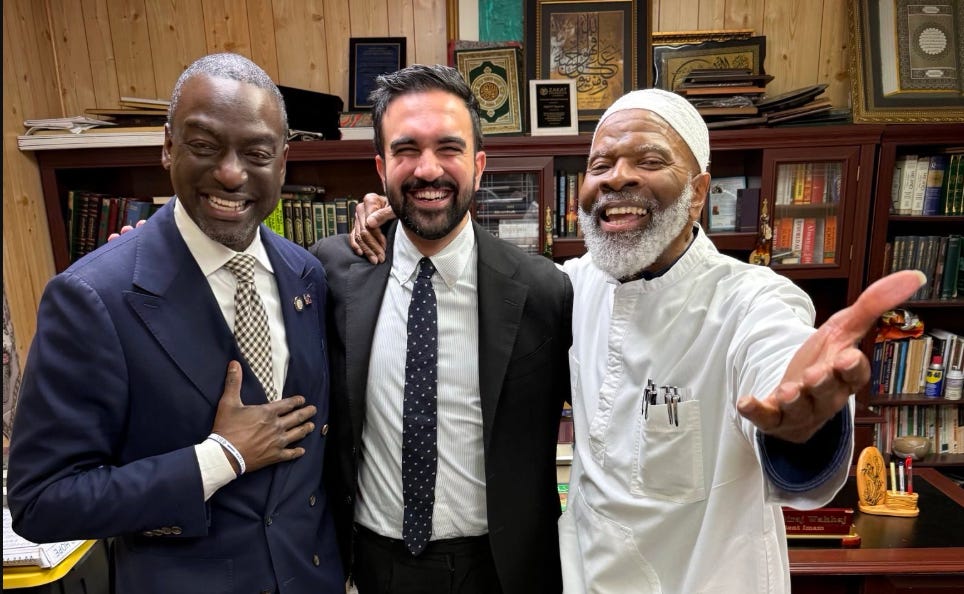
On Friday, New York mayoral candidate Zohran Mamdani posted a photo of himself with Councilman Yusef Salaam, one of the exonerated Central Park Five, and Imam Siraj Wahhaj, the leader of Masjid at-Taqwa in Bed-Stuy and a prominent voice in his community. The imam, Mamdani said, has been “one of the nation’s foremost Muslim leaders and a pillar of the Bed-Stuy community for nearly half a century.”
Wahhaj is also controversial, and the New York Post immediately pounced, running the headline “Mamdani appears smiling, arm-in-arm with unindicted ‘93 WTC bombing co-conspirator and terrorist apologist.” Mamdani pushed back, pointing out that former New York City mayors Bill de Blasio and Mike Bloomberg met with Wahhaj as well. His meeting with the imam is only an issue now, Mamdani said, “because of the fact of my faith and because I’m on the precipice of winning this election.”
I’m not sure it’s true that this is an attack on Mamdani’s faith, although he has been attacked for his faith, and he is definitely being attacked now because he’s on the precipice of winning this election. As Mamdani pointed out, Bloomberg also met with Wahhaj as part of a larger gathering with Muslim leaders who spoke with the mayor about religious divides in the city — and the tabloid blowback was intense enough that Bloomberg had to apologize, and said that if he had known the imam’s views, he wouldn’t have invited him. So it’s not quite as simple as “everyone thought this imam was fine until the Muslim candidate met with him.”
But it’s also not the case that Wahhaj is some sort of fringe or widely disgraced figure and Mamdani meeting him is making A Statement. Wahhaj gave an invocation before the House of Representatives in the early 1990s, the first imam to do so. His Bed-Stuy mosque is an important community hub, and he founded it back when the corner was home to significant crime and despair, using his space as one tool to bring stability and safety to the broader community. Right-wing media is portraying him as a radical jihadi; in truth, he’s a guy who joined the Nation of Islam in the aftermath of Martin Luther King Jr’s assassination and is now an orthodox Muslim who has said his fair share of ugly things, who has conservative views on gender that I find personally abhorrent and a vision of political Islam that I find odious, and has also done a lot of good for his flock and community. This puts him pretty in line with many other religious figures who remain in good standing on the right and left alike. It is totally wild but unsurprising to see conservatives losing their minds over Mamdani visiting this mosque when the Trump administration is staffed up with unapologetic Christian nationalists who oppose gay rights and want Biblical law to rule America, and when the broader Republican Party has taken a turn toward what can only be described as the Hitlerian. Pete Hegseth follows a religious leader who has said that “Women are the kind of people that people come out of” and defines us as the “weaker vessel,” and Hegseth himself reposted a video of that same pastor saying that women shouldn’t have the right to vote. Trump has pardoned all sorts of criminals, including insurrectionists who went on to commit other serious and sometimes violent crimes. Trump himself just posted an AI of video of him dropping feces all over the country. A man who uses his office to send the message that he shits on America doesn’t have much in the way of the moral high ground here against “anti-American” religious leaders.
But pulling the hypocrisy card doesn’t do the trick here. “The other guys do it and they’re worse” isn’t a justification for betraying your values or your voters. The more important questions here are ones of principle. How should mayoral candidates engage with potential constituents, including those whose ideologies might upset or repel many of their fellow citizens? What’s the line between campaigning with someone or visiting a constituency and endorsing their views? How should progressives think about and talk about bigotry justified by religion?
New York City mayoral candidates have to appeal to various constituencies, and when they’re running for office their job is to get votes, which means they should talk to just about anyone and everyone. An appearance at a religious institution is not an endorsement of that institution or its leaders. The freakout about Mamdani taking a photo with this imam is radically overblown. Of course he should visit this congregation. Of course he should talk to all kinds of different New Yorkers who believe all kinds of different things.
Progressive activists, though, should behave differently. And all politicians have an obligation to be clear about their views and aims. It is one thing to show up at a church, mosque, or synagogue and speak to the congregation about your campaign and your plans for the city. It’s another to endorse or promote what that institution is doing. And progressives generally need to be consistent here: If we wouldn’t accept or ignore a particular view or statement from a Christian leader, we shouldn’t accept or ignore it from a person of any other faith. I see progressives (rightly) standing against Islamophobia, and Mamdani has certainly been on the receiving end of an enormous amount of anti-Muslim bigotry. But it’s not Islamophobia to have consistent views on things like gender equality, religious freedom, and gay rights, and to object when you see powerful people embrace those who would curtail those rights and freedoms, even if the embrace is under the guise of religious belief. And it is the job of progressives to hold the line on these issues, even when it’s politically expedient not to.
