

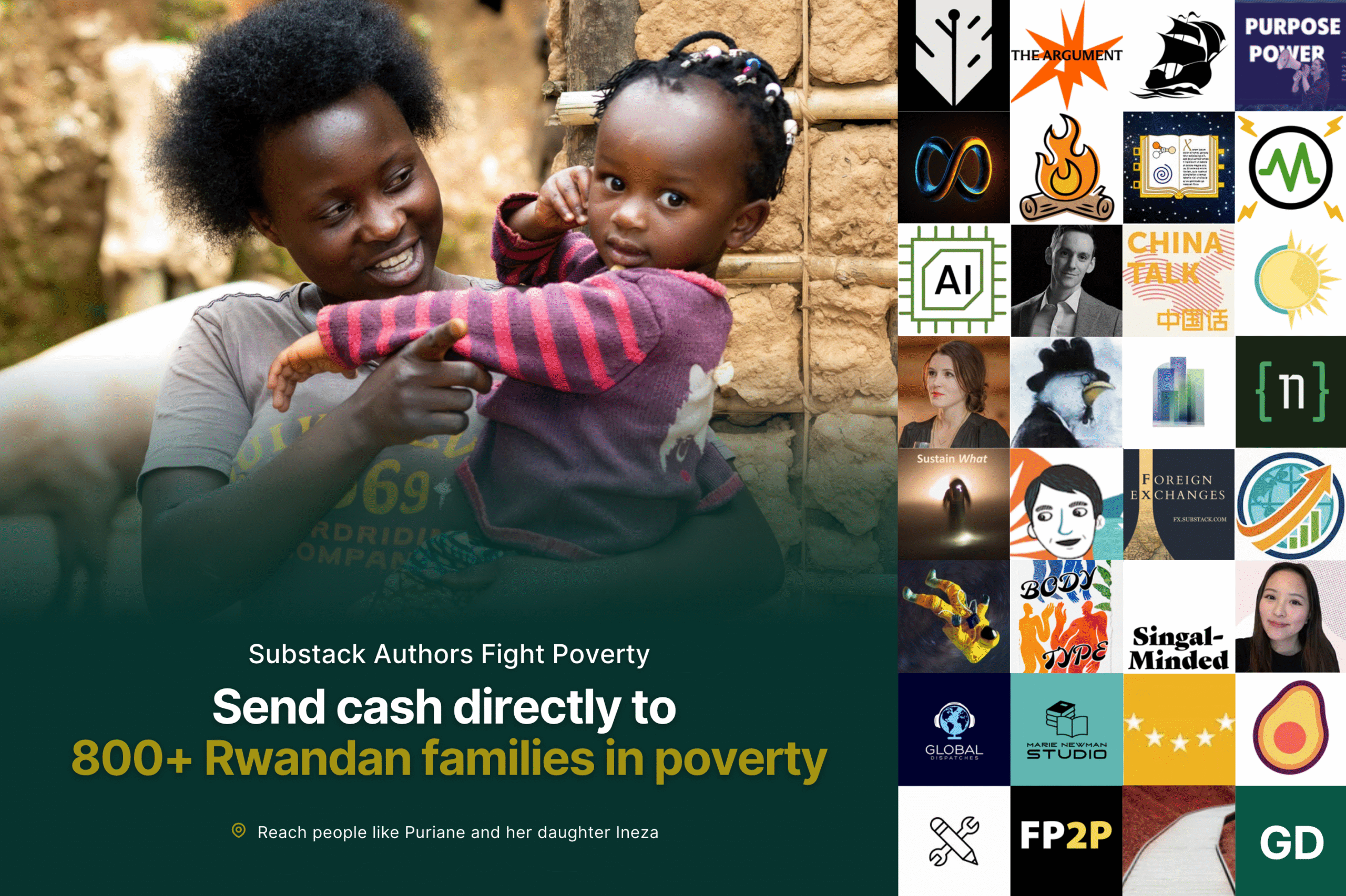
Hello readers, and happy Giving Tuesday, a global day of donating to the causes we care about. This is mine. This year, I’m again joining some of my favorite Substackers, including Jerusalem Demsas and her team at the Argument, Mark Leon Goldberg of Global Dispatches, the Bulwark, Derek Thompson, and Matt Ygelisas of Slow Boring to send thousands of dollars to villagers in Rwanda. Your donation is tax deductible and 1.5x matched, and I’m hoping you can all help get us to our goal.
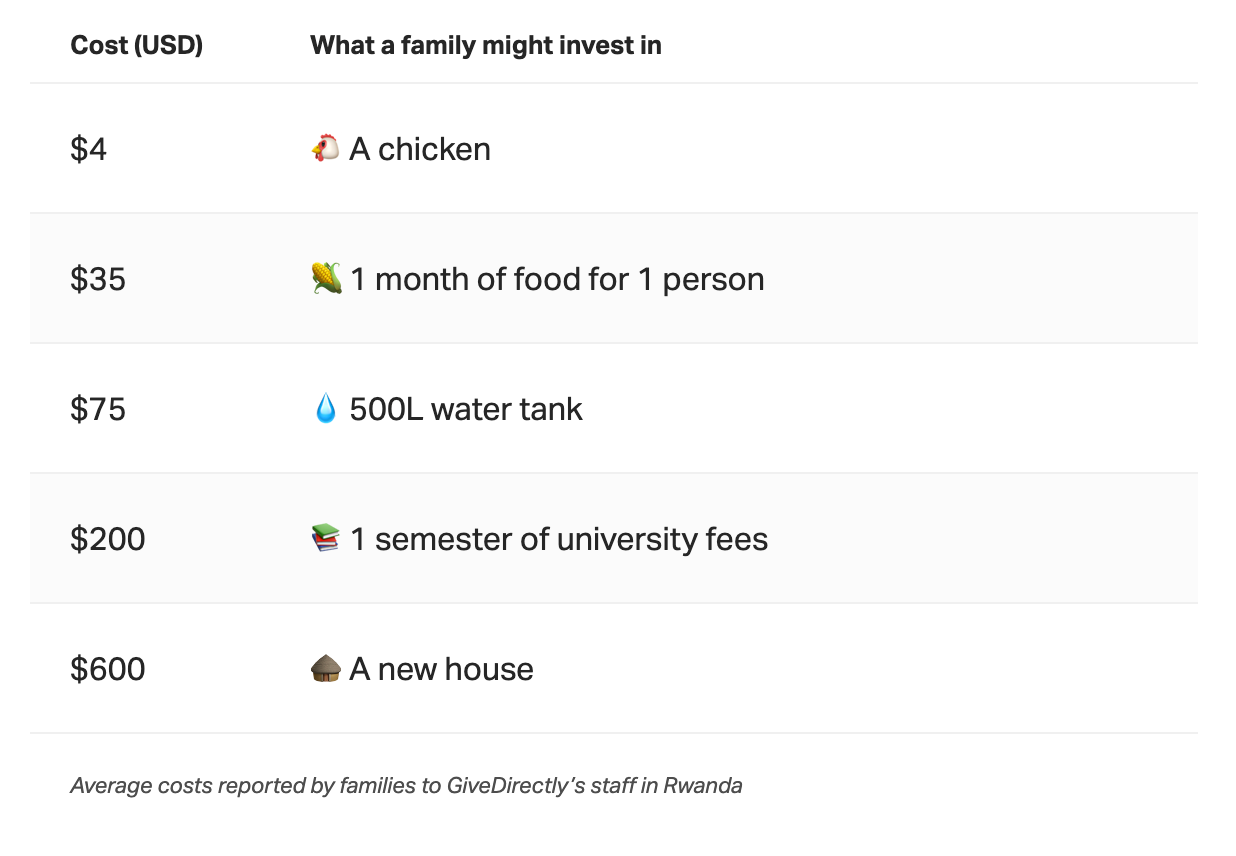
Here’s what your money can cover for families living off of a dollar or two per day:
I’m a big fan of unconditional cash transfers for poverty alleviation. It’s a pretty simple idea: If people are poor, one answer is to give them money. But it’s also a pretty controversial one: There are all kinds of assumptions about how poor people will squander their funds, and fears that cash transfers will discourage work, as well as arguments that what people actually need are services provided by other entities and institutions. And people do need lots of services provided by other entities and institutions, including their own government. But poor people also need money. And given that most people have agency and want to be treated accordingly, one of the most empowering things you can do is trust a person to spend money in the way that would benefit them most. Plus, it works.
This isn’t just ideology talking. Unconditional cash transfers:
Are more effective than job training programs in improving the economic situation of unemployed young people
Decrease hunger and are more effective than shipping people food
Empower women and significantly decrease domestic violence
Improve maternal and infant health outcomes
Do not decrease hours worked
Contribute more than double to local economies
Lead to higher earnings years later
Cash transfers aren’t the whole solution for addressing global poverty. But they’re an important component. You may have heard that a recent study called direct cash transfers into question, so I want to offer a point of clarity: That was a single study of whether cash payments in the US helped improve child development outcomes, and it spanned the Covid pandemic, when significant government cash payments were also sent out. It’s an interesting study but it has serious limitations, and doesn’t have much to do with direct cash giving to the world’s most impoverished communities. I mention it only because it’s the reason direct cash transfers have been in the news, and I don’t want readers to be confused about the efficacy of these initiatives.
People often just need a little help, and once they get it, they can thrive. I’ve certainly had a lot of support in my life. Maybe you have, too. This is an opportunity to provide simple, straightforward, respectful support to people who need it, in a form that treats the recipients with trust, agency, and dignity.
The donation page is here. Please feel free to share widely, and of course let me know if you have any questions. I hope you’ll join me in putting cash into the hands of Rwandan families for whom it will make a world of difference.
xx Jill
I'm glad you're doing this and I'm happy for the opportunity to contribute.
In terms of hunger, while cash is more effective than food shipments for this initiative in Rwanda, I wanted to point out that in the United States, generally the most effective way to combat food insecurity is to give cash to local food banks and local food pantries because they are able to procure food very efficiently.