


Is it wrong to steal lemons from Whole Foods? To steal paintings from the Louvre? To kill health care executives?
Last week, the New York Times published an interview with writer Jia Tolentino and streamer Hasan Piker about the purpose and morality of petty and not-so-petty crimes in a country where the ultra-wealthy do not seem to play by the same rules as the rest of us. It’s worth a listen, because I think it illustrates a critical flaw in too much of today’s left (a group of which I still consider myself a member): In the pursuit of equality, we too often race to the bottom instead of creating conditions for more people to rise to the top.
In the interview Tolentino (a writer whose work I admire) admits to occasionally swiping lemons or a loaf of bread from Whole Foods if she’s already gone through the checkout, paid for her groceries, and then realized she forgot one thing on her list (something she was getting for a neighbor who put the Whole Foods order in via a local mutual aid group). This admission has spurred an absolutely massive backlash, with a truly repulsive reporter from the Daily Mail showing up to her home to confront her and then publishing a piece that emphasizes the price of Tolentino’s brownstone and her “second home in the ritzy upstate New York town of Saugerties,” a cabin that she and her husband bought for… $200,000 (lol on several counts).
The lemon scandal feels very, very silly, especially since Tolentino repeats many times that collective action and reigning in exploitative companies is the path to change — the only viable path to a better, fairer society. But, she rightly notes, it’s hard to do.
The interviewer, Nadja Spiegelman, talks about shoplifting and says, “My friends and I have started calling this microlooting, because it has a slight political valence to theft, as opposed to just the thrill of getting away with something. Have you noticed this around you online? Have you noticed more people talking about stealing in this way?”
And Tolentino responds:
Microlooting — it feels akin to posting about something. As an atomized individual action, it’s useless. It’s much harder to get a job and accept $17.50 an hour and then to organize your colleagues, a process that takes years and is often unsuccessful.
The thing about actual collective, direct action — it’s so much harder. And it often doesn’t profit you whatsoever, such as, you know, me getting an extra 10 bucks by grabbing my extra loaf of bread for Miss Nancy.
We are also lazy as humans; we’re also selfish. We’ve lost not only the language and the union density and the structure to engage in things like this, but we have also lost the muscle that is built up to be able to engage in these sorts of things. We’ve lost the rooms in which these things are planned.
Tolentino and Piker are being lumped into the same category of “leftists who like stealing and murder,” but in reality they say very different things. It’s Piker who really seems to revel in the idea of individuals who engage in violence, thievery, and sabotage, even as he personally does not steal after being punished as a child for it by his dad. The one point in the interview where I paused, a bit stunned, is when they both agreed that’s it’s fine to steal from the Louvre. This was, to be fair, said in a jokey tone — a “more cool crimes please!” kind of thing. And I too like movies and podcasts about art heists. In reality, though, art museums are places where incredible works of human creation are made available to the public — stealing them for personal benefit and ensuring they will be hidden from public view and living in the private collection of some extremely rich person strikes me as the opposite of the socialist ideal. So it’s also been shocking to see other leftists genuinely coming to the defense of “steal from the Louvre,” not just because doing so is cool, but because they have more paintings in the basement.
There doesn’t seem to be much of a theory of change here. Tolentino provides one, but that’s largely ignored in both the interview and the discourse around it. Some leftists and socialists, like Piker and Spiegelman’s “micro-looting” friends, seem to believe that acts that feel transgressive are themselves political activism. It reminds me a bit of the cyclical feminist discourse about beauty culture (and a bunch of other things): If you’re wearing lipstick and high heels is that Feminist because you are a woman who is choosing her choice? If something feels good to you, and you are a woman, is that thing Feminist? My answer is no, of course not. That’s not an argument against feeling good, or against wearing high heels or red lipstick; I do all of those things. It is an argument against the self-flattery of believing actions one simply prefers to take have some political impact. We all comply with our culture’s expectations of us to some degree, and sometimes that feels good. Most of us will transgress those expectations too, and often that can feel good because it’s thrilling. But just as cheating on your husband is probably not a feminist action simply because marriage is a patriarchal institution, stealing from Whole Foods is not a socialist action simply because Whole Foods is a company in a capitalist nation. I personally find the idea of shoplifting to be so anxiety-producing that I cannot imagine doing it, and the one time I did do it (eighth grade) it was by accident — I walked out of a shop holding a Bush sticker I intended to buy, forgetting it was in my hand — and I went back and paid for it. But I can certainly comprehend how shoplifting is a little thrill for some people, and I generally feel like whatever — just be honest that it’s wrong, you know it’s wrong, and that’s why it feels fun. It’s not some great act of anti-capitalist transgression.
But it certainly might be fueled by a sense of frustration and bitterness at an unequal and exploitative system.
It’s easy to understand how resentment over rank inequality — not just inequality in terms of wealth, but inequality in obligation and accountability — curdles into antisocial action. A great many benefits are handed to the wealthy, from lower-interest loans to fee-free banking; it really does pay to be rich, while it’s expensive to be poor. Many billionaires have a lower tax rate than I do. Over the last few decades, wealth has exploded at the very tippy-top, while life feels increasingly precarious for the vast bottom and even the middle. America is far behind many of our peer nations in benefits citizens of other developed countries take for granted: Universal healthcare, paid parental leave, affordable childcare. Many billionaires avoid paying the taxes that would support the broader society that has supported them in amassing spectacular wealth; worse, many use their spectacular wealth to put their thumbs on the political scales, buying greater political representation in a system that promises one person one vote.
But there’s something else particular about America: We’re a much more dangerous country than most of our economic peers. We have significantly higher murder rates, thanks to our unique proliferation of weapons designed to murder. And we have pretty middling rates of social trust — not as low as countries with astounding rates of crime, corruption, and violence (Brazil, Nigeria, and so on), but lower than the high-trust societies of Scandinavia, and lower than Australia, Canada, and the UK — and much lower than China, despite that country’s authoritarian government and aggressive surveillance state.
There’s a pretty clear pattern to the countries with high social trust. They tend to have low levels of corruption, low levels of inequality, and robust social safety net programs. The United States, interestingly, is an outlier: Given how unequal our country is, we should be less trusting than we are:
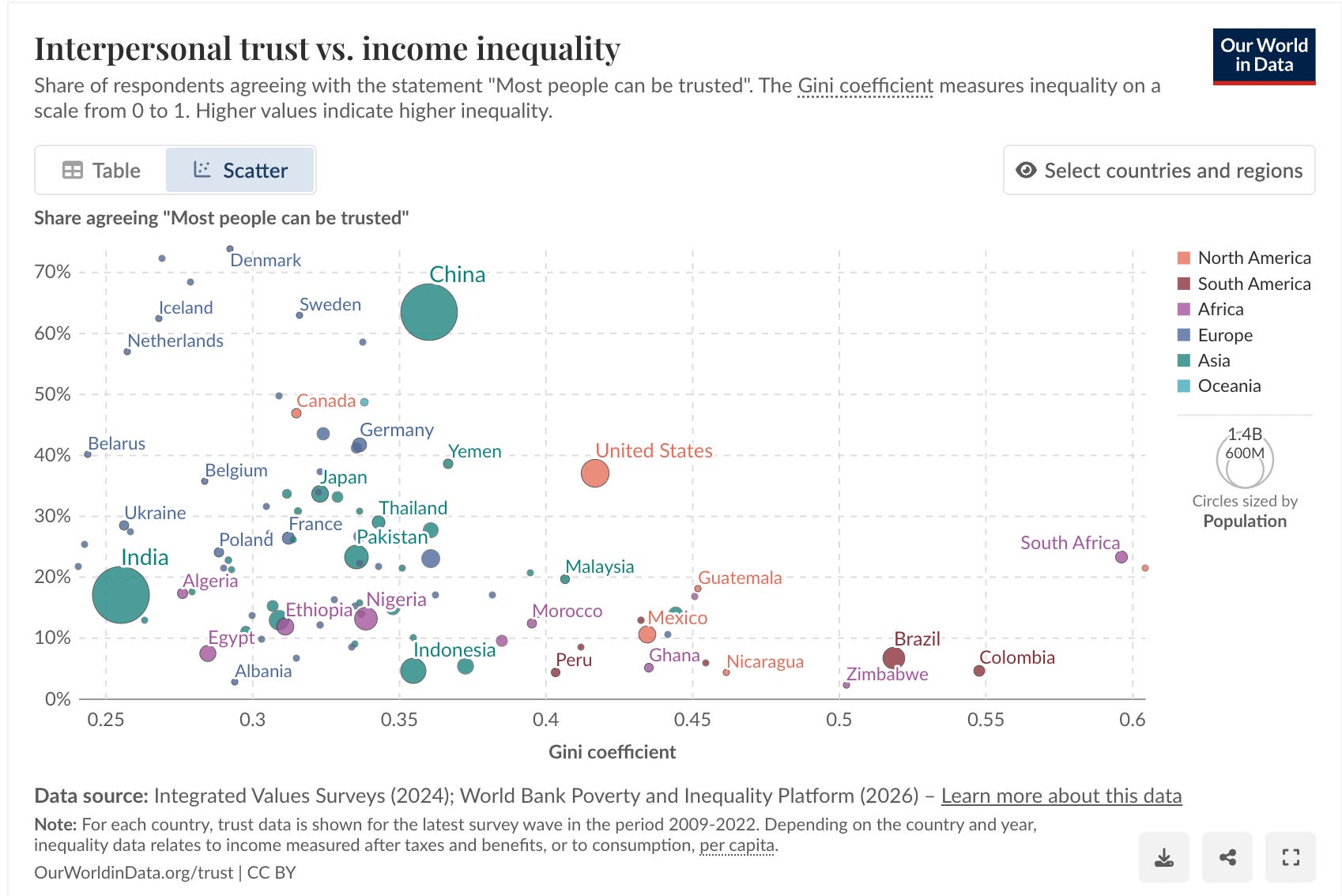
I would bet that social trust in the US will decline in the Trump era, as we watch the people in charge loot their way through office while half the country cheers them on. This is a shame, not just because social trust feels good, but because it also drives economic productivity and generally makes countries and communities more pleasant and prosperous places to live.
I have lived in very high-trust societies and very low-trust societies. In Hong Kong, I could leave my laptop on a coffee shop table and go to the bathroom without worrying it would be stolen. In Nairobi, I wouldn’t go to bed at night without locking two layers of doors, and wouldn’t walk most places during the day or anywhere after dark (Kenya has one of the lowest levels of social trust in the world). I loved living in Nairobi and would like to do so again — I would choose to live there over Hong Kong — but you can probably guess which city offered a lower-stress day-to-day. These vast differences in both perceived and actual safety didn’t come out of nowhere. Hong Kong is a a wealthy and well-resourced city where everyone is surveilled in public all of the time (and some people are surveilled in private, too); CCTV is everywhere, law enforcement is strict, and it’s part of a broader authoritarian nation. Kenya is a poorer country with high levels of corruption especially among the political elite but also among law enforcement, which isn’t weak, exactly, but is a combination of pay-to-play (or pay to get out of trouble), arbitrary, and brutal. Kenya was a freer country in terms of one’s ability to speak and advocate. But it was a more restrictive country in the sense that, in its largest city, one could not move through public space with near-total confidence that one would be physically safe, remain in possession of one’s property, and not get run over by a car.
Living in Hong Kong, I understood how authoritarian regimes that deprive people of many individual freedoms can nevertheless enjoy broad public support if they also offer widespread public safety and an endless array of consumer goods. People who enjoy things like free speech, personal privacy, and liberal democracy are almost definitely going to have to accept higher levels of petty (and probably serious) criminality in exchange for a freer society, and to me, that’s a fair enough trade. But people who enjoy things like free speech, personal privacy, and liberal democracy should also take note of the very basic human desire to feel safe and to be able to trust one’s fellow citizens — because when those things are lacking, people look around for someone to blame, and that’s usually not the conservatives promising to restore public order by any means necessary.
Trust researchers define interpersonal trust more or less as “a person’s willingness to accept vulnerability to another conditioned on expectations regarding the other’s behavior.” The primary determinants of trust are ability, benevolence, and integrity: Do you believe that the person you’re considering trusting is competent to do whatever it is you’re trusting them to do; do you believe they demonstrate “caring, goodwill and empathy, responsibly fulfilling obligations, and goal commitment;” and do you see in them “objectivity, fairness, and accurate/honest communication.”
Billionaires who don’t pay their taxes and use their resources to undermine public goods for everyone else also undermine public trust. Politicians who enrich themselves and lie to the public definitely undermine public trust. But a politics of “they’re bad, so I will be bad, too” doesn’t exactly restore it.
I suspect the argument is that if the masses stop behaving, the powerful will either see an impending threat and start to enact the changes necessary to create a fairer society, or the badly-behaving masses will become so comfortable with disorder that they’ll bring about the revolution. I am skeptical that this theory is grounded in reality or history. Successful movements have required significant trust among participants, which is why one of the primary ways to undermine them is by infiltrating them and sowing distrust. Successful movements that didn’t turn authoritarian have also historically built trust with the broader public — the public has to believe that whatever movement is trying to change laws or norms or both is competent, has their best interests at heart, operates with integrity, tells the truth, and has strong principles. “Stealing is good because corporations are bad” does not exactly build trust, suggest a politics of honesty and integrity, or encourage people to believe you have their best interests at heart.
When public order and sense of communal obligation breaks down, what I have personally observe happen is not that the fearful wealthy begin to behave benevolently. What I have observed is that they secret themselves away more effectively: Hire more security, live in gated-off neighborhoods, privatize more spaces for themselves. The ultra-wealthy certainly believe themselves to be suffering in places where public trust is low, which tend to also be places where crime is high and inequality wide; they feel vulnerable and behave accordingly. The result, though, is not that they suffer in proportion to their wealth; the result is that the poorest and least-resourced are the ones who are hurt the most by social breakdown, while the wealthiest retreat further and further from it.
In short: Tolentino is right that individual acts of theft or destruction are not the kind of collective action necessary to bring about real change. But I would take it a step further, and almost certainly further than she would: Individual acts of theft, destruction, and violence done in the name of progressive politics undermines those very politics.
And when progressives ignore or justify theft, destruction, and violence because of progressive politics, we also undermine those very politics — and hurt the people we’re trying to help.
This requires some judgment. You may have heard that diapers and baby formula are among the most-shoplifted items from grocery and drug stores. It makes sense for progressives to look at that piece of information and conclude that the state needs to do more to get diapers and baby formula into the hands of low-income mothers, and that a harsh law enforcement reaction is the exact wrong response. This is the Jean Valjean scenario, and it’s hard to be angrier at the woman swiping the baby formula than at the affluent society that doesn’t ensure every baby has enough to eat. But it’s also the case that criminal organizations began stealing diapers and baby formula in bulk because those items are always needed and have high resale value, and that’s part of the reason you now have to ask a CVS employee to unlock the case holding the deodorant you’d like to buy. That annoys everyone — and while the public gets mad at CVS about it (or, more often, at individual working-class CVS employees), I suspect that most people are also mad at the organized shoplifters who the stores are trying to keep from stealing. Every trip into an urban drug store is a stark visual reminder that the people around you can’t be trusted (not to mention a very annoying logistical reminder that everything just kind of sucks). That degrades not just public trust, but progressive politics. Conservatives inevitably blame public disorder on liberals, and while that’s untrue for serious violent crime — America’s absurd homicide rate is largely the fault of the lax gun laws conservatives demand — progressives don’t help ourselves when we deride or mock people who are troubled by mass shoplifting, urination on the subway, people in the throes of addiction sleeping on the sidewalk, and other signs that the system is not working. The lady stealing a pack of diapers isn’t the problem. Punitive punishment is often not the solution. But when organized thieves steal diapers en mass for resale and profit, that has downstream negative effects on the public and the lady who actually needs the diapers. One of those effects is the breakdown of trust, which, from what I’ve seen, is a conservatizing force.
This same impulse — make everyone more equal by lowering standards, thereby making things worse — has become a troublingly common left-wing solution in recent years, from education to public order. We can actually make things better and more equal by raising standards, enforcing existing laws, and creating a better policy landscape so that the average CEO no longer makes 281 times the average worker — and the average worker can feed her kids, diaper her baby, and get cancer treatment without bankrupting her family. Getting there requires taking the long view. It requires action and activism and the willingness to slog through the intentionally slow, vastly imperfect democratic process. It’s not as cool as stealing from the Louvre. But it definitely helps more people.
xx Jill