

I pray that most of you are not Online enough to have followed the now week-long Discourse on DoorDash and home cooking, spurred on by this New York Times article about the people who are spending $300 a week on DoorDash because they can’t cook for themselves. Social media went nuts, with responses ranging from “it is very easy to cook at home, just buy a box of pasta and a jar of tomato sauce” to “actually it is very hard to cook at home, you might have to decant black olives.”
I am a moderately enthusiastic home cook, and I’ve cooked in a variety of settings with an even wider variety of available ingredients (a teeny-tiny kitchen with one burner and no dishwasher in Hong Kong; expansive kitchens with limited familiar ingredients in Nairobi and Hanoi; a big pantry in upstate New York, but every trip to the grocery store requiring getting in the car, which I hated and sought to minimize). Here is what I have learned: If you are a person with limited time and limited space, the easiest way to cook is to find a few easy dishes you like (between three and five is a good number), and always have the basics on-hand to make them, perhaps save some fresh vegetables + a protein you can grab on the way home.
I mentioned on Twitter that I wanted to make a pantry-stocking guide for the people who don’t know where to start when it comes to cooking at home, but the people who most need it probably won’t use it. And a bunch of people said, “no, please make it!”
So here it is.
This at-home pantry-stocking and recipe guide is for you if:
You want to cook healthy food at home mostly from scratch. If you are more of a Trader Joe’s microwave meal person or someone who is happy boiling noodles and pouring jarred sauce over them, great! But then this guide might not be all that helpful for you.
You are looking for recipes that are simple and quick, but still require some use of the stovetop / oven. If you are, for example, the kind of person who wants to chop up and cook a bunch of ingredients every Sunday and then assemble power bowls for yourself throughout the week, great! There are tons of guides for that. This is not one of them.
You want to be able to re-use the same handful of ingredients a bunch of times. Here, I give you ingredient lists by broad food types (Italian-Mediterranean, East Asian, South Asian, and Mexican-ish), as well as recipes that use and re-use those same ingredients. Most of these also scale up really well, so do double the recipes and eat leftovers for a day or two. This is an omnivorous guide, but I’ve included some vegetarian and vegan options in each section.
You want to be able to master three or four simple, tasty dishes that you can easily cook on rotation. This is not a guide to a pantry that has everything. It is a guide for people who want ease and efficiency.
You want a bare-bones guide, not a comprehensive list of everything an ambitious home cook needs. My personal pantry is a lot larger than this, and I am sure readers will have a lot to say about what I’ve left off, but this is about the very very basics.
There are a lot of “How to Stock a Pantry” guides out there. Here are two I particularly like (and here’s a bonus third). But as I see it, the main flaw of these guides is that they’re for a general consumer, and you are a specific consumer. You have certain food preferences and, if you start cooking more regularly, you’ll realize you have preparation preferences. Identifying those preferences will go a long way to making your pantry useful. For example: I don’t love baked goods, and I don’t love to bake, so while I do have flour in my pantry, I don’t have a bunch of different flours or sugars or baking chocolates. You might be different! But if there are whole categories of food you just don’t really eat or don’t enjoy making at home, you don’t have to stock your pantry for them just because the guides tell you to.
The below is a guide to stocking a home pantry that will suit your needs and preferences.
This guide is also long, so I’ve divided it into two emails, each focusing on a few cuisines. Yes I know there are 1,000 other cuisines out there, but these are good, basic, flavorful places to start. In this first email, you’ll find:
Figuring out what kind of home cook you are and what kind of pantry you want to stock (in other words, what kind of food you like).
The absolute bar-bones basics that every pantry needs.
A pantry guide for the person who just wants to cook simple proteins + vegetables.
A pantry guide for the person who likes Italian / Mediterranean food.
In the second email you’ll find:
A pantry guide for the person who likes East Asian (very loosely Thai / Vietnamese / Korean / Chinese) food.
A pantry guide for the person who likes South Asian (very loosely Indian subcontinent) food and the related flavors.
A pantry guide for the person who likes vaguely Mexican food and flavors.
Figure it Out: What Kind of Home Cook Are You?
What do you like to eat?
The key to stocking your home pantry with staples so you can easily cook at home is to know what you actually want to eat at home. My top advice is to pick a limited number of different cuisines / flavor profiles. Many cuisines use a small number of ingredients in a variety of different ways, so if you can identity two or three general cuisines you like, you can stock up your pantry with things you’ll actually use.
Whose recipes do you like?
One of the best hacks you can find as a home cook is to find a recipe writer who cooks like you — who cooks food that tastes the way you like, in a way that feels accessible. You will eventually notice that recipe writers also tend to have a few favored cuisines and methods, and their oft-used ingredients can shape what you stock. I share a bunch of recipes below, and you might notice that there are a handful of recipe writers who come up again and again: Melissa Clark, Colu Henry, Alison Roman, and Mark Bittman are on heavy rotation in my house. If you find a recipe you love, a good way to expand your cooking repertoire is to see what else the recipe writer has published.
Where are you willing to put in a little effort, and what feels more onerous?
Part of the problem with “easy” recipes is that people define “easy” in a lot of different ways. Personally, I don’t think a recipe is “easy” if I have to chop up 12 different ingredients, and I enjoy the cooking part of making food more than the prep part (this is why I almost never make complex salads at home for lunch or dinner, even though this is a healthy option that requires very little cooking). You might be different — for you, spending an hour every three days chopping up a bunch of ingredients you can then throw together in bowls all week may sound much easier than spending 30 minutes each evening cooking a hot dish for yourself. Read through a recipe to understand how much chopping vs. marinating vs. actual cooking goes into it, and move forward according to how you prefer to prepare your food.
Ok, get shopping!
The Pantry Basics
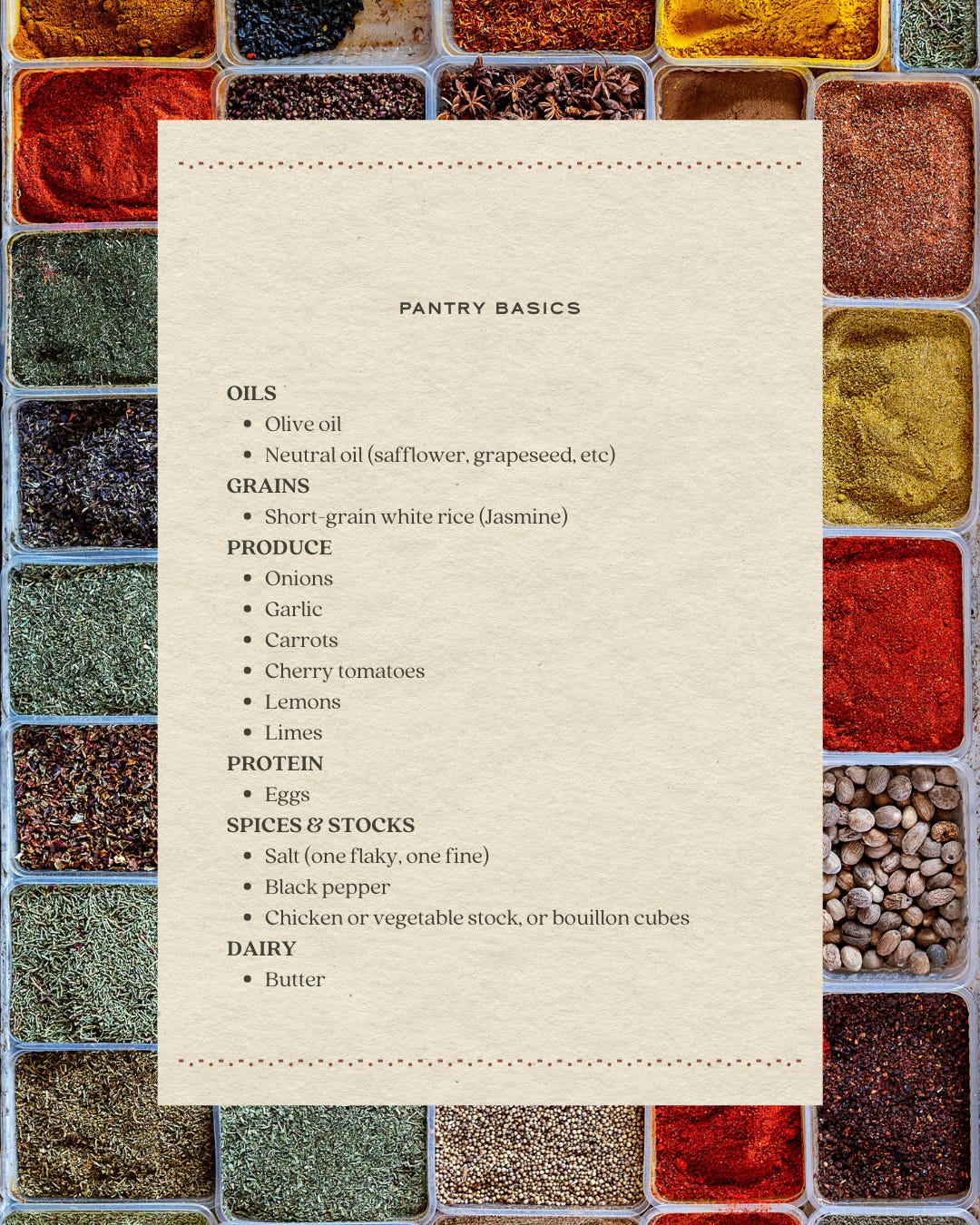
These are the things you should probably have on hand no matter what you like to cook, as they will adapt to many different cuisines. These items are in many of the below recipes, regardless of cuisine type.
Oils: Extra-virgin olive oil and a neutral oil (like safflower, canola, vegetable, or grapeseed).
Grains: Short-grain white rice (I usually go for Thai jasmine rice).
Fruits and Vegetables: Onions, garlic, carrots, cherry tomatoes, lemons, limes.
Spices: Salt and pepper. I like one flaky salt like Maldon and one fine iodized salt. I like whole black peppercorns that I put in a grinder.
Stocks: I always have home-made chicken stock in my freezer, but a store-bought stock is fine. If that takes up too much space, get some Better than Bouillon cubes. Use vegetable stock if you prefer.
Fridge: Butter, eggs.
Misc: Foil or parchment paper.
Tools: A Dutch oven is one of the best multi-use kitchen tools you can buy. If you also have a 12-inch skillet and a pot for boiling water, your basics are covered. You should also have: a rimmed baking sheet; a ladle; a wooden or slotted metal spoon; a whisk, a spatula, a grater (I use my microplane almost every day), and tongs. I tend to stick with stainless steel and I avoid anything plastic.
For storage, I use glass jars for all of my basics (pastas, dried beans, flour, sugar, nuts, rice, and so on) and glass storage containers instead of plastic tupperware. I also try to buy my condiments and whatnot in glass containers, then wash and re-use them. But any kind of storage containers will do. The key is being able to see what ingredients you have.
The Simple Protein / Simple Veg Pantry
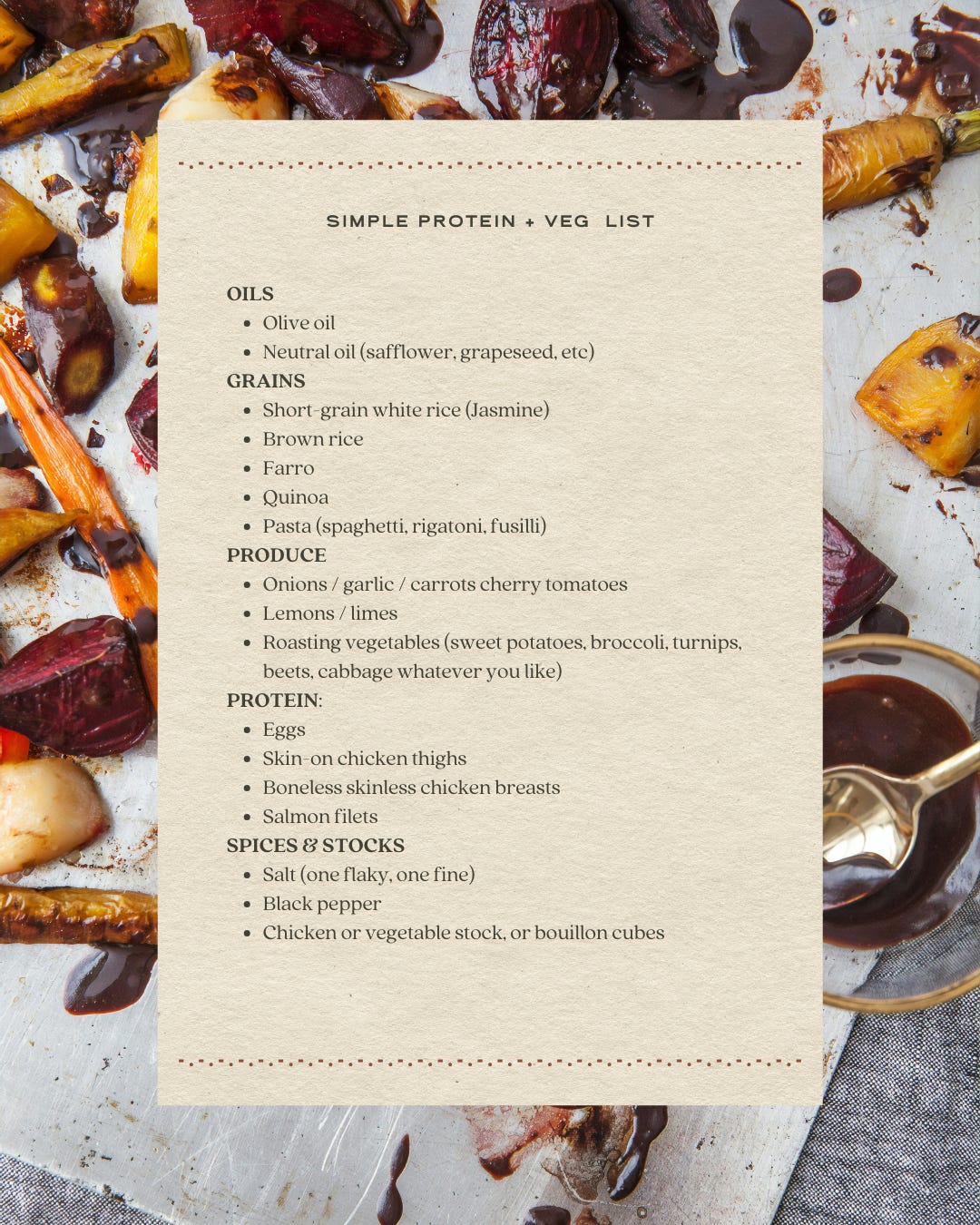
If you are a person for whom a perfect meal is a simple protein (fish / steak / chicken / etc) coupled with a healthy vegetable or two, or if you’re a person who wants to meal prep for the week, then this is your pantry (adding on to the basics above):
Grains: Do you like a grain with your protein/veg meal? Add your favorites: Brown rice, quinoa, farro, couscous, pasta (for pasta, I like having one long noodle, like a thick spaghetti, and one short noodle, like a rigatoni or fusilli).
Root vegetables: The basics + red onions, shallots, and whatever easy roasting vegetables you like to eat: Sweet potatoes, regular potatoes, squash, bell peppers, zucchini, Brussels sprouts, cabbage, broccoli, cauliflower, parsnips, beets, turnips. Definitely don’t buy all of these at once! See what the recipe calls for, or see what looks good at the market, pick two or three, and eat them all week.
Other fruits and vegetables: Cherry tomatoes (they last forever and tend to be more flavorful throughout the winter).
Proteins: This is obviously choose your own adventure, but some of my preferred proteins that are simple to cook and easy to find include salmon, cod, shrimp, chicken breasts, chicken thighs, pork cutlets, and skirt or flank steak.
Spices: Smoked paprika, cumin.
Recipes:
Roasted vegetables. The basics: Cut your vegetables into a uniform size. Toss them in oil (I tend to use olive oil), salt, and pepper; you can add paprika or cumin if you like those flavors. Put them on a sheet pan in one layer (if your vegetables are all smooshed and stacked, they won’t roast well). Roast at 425 until you start to see some crispy spots. For most root vegetables, this is 30-45 minutes.
Cold-oven chicken. This is my go-to easy, incredibly flavorful chicken recipe. I cannot tell you how good this chicken recipe is.
Chicken with schmaltzy cabbage. This is my other go-to roast chicken recipe. Again, you can do it with skin-on thighs or a whole chicken. You roast the chicken on a bed of cabbage and garlic, so you have vegetables and a protein all in one pan. (I usually make a second sheet pan of cabbage and garlic tossed with olive oil and a little butter because it’s just so good).
Salmon and tomatoes in foil. Another practically fool-proof flavor-packed recipe with a small number of ingredients. I love a fresh herb, but I’ve also made this one without the basil and it’s still great. You could probably also toss in some asparagus spears for an extra vegetable.
Simplest baked chicken breasts. If I was a “lean protein meal-prep” person for whom variety and intense flavors weren’t a priority but ease and health were, I would bake several boneless skinless chicken breasts on one sheet pan, a bunch of root vegetables on another sheet pan, and eat that for the next few days. This recipe calls for Italian seasoning which sounds like a great simple add-on, but you can also just do it with salt, pepper, and paprika (or just salt and pepper). If it were me, I’d squeeze a lemon over it before eating. You can also sub in pork cutlets here. And you can pan-roast shrimp, too, or just dry them with a paper town and cook them on the stovetop in a pan with olive oil and paprika.
Super-easy soups. This is how I eat like… 60% of the time. I love a chicken and vegetable soup, for which I do not have a recipe but the easiest way is to chop and sauté one onion, two carrots, two celery stalks, and four garlic cloves for a few minutes, sprinkle on some salt, pour in chicken stock and add two chicken breasts, bring to a boil, reduce to a simmer, pull the chicken breast out when it’s cooked through (15 min or so), shred with two forks, add back in, you’re done (you can also cook noodles, rice, farro, etc separately or in the soup). Also try: Root vegetable soup and cabbage, potato, and leek soup.
The Italian-Mediterranean Pantry
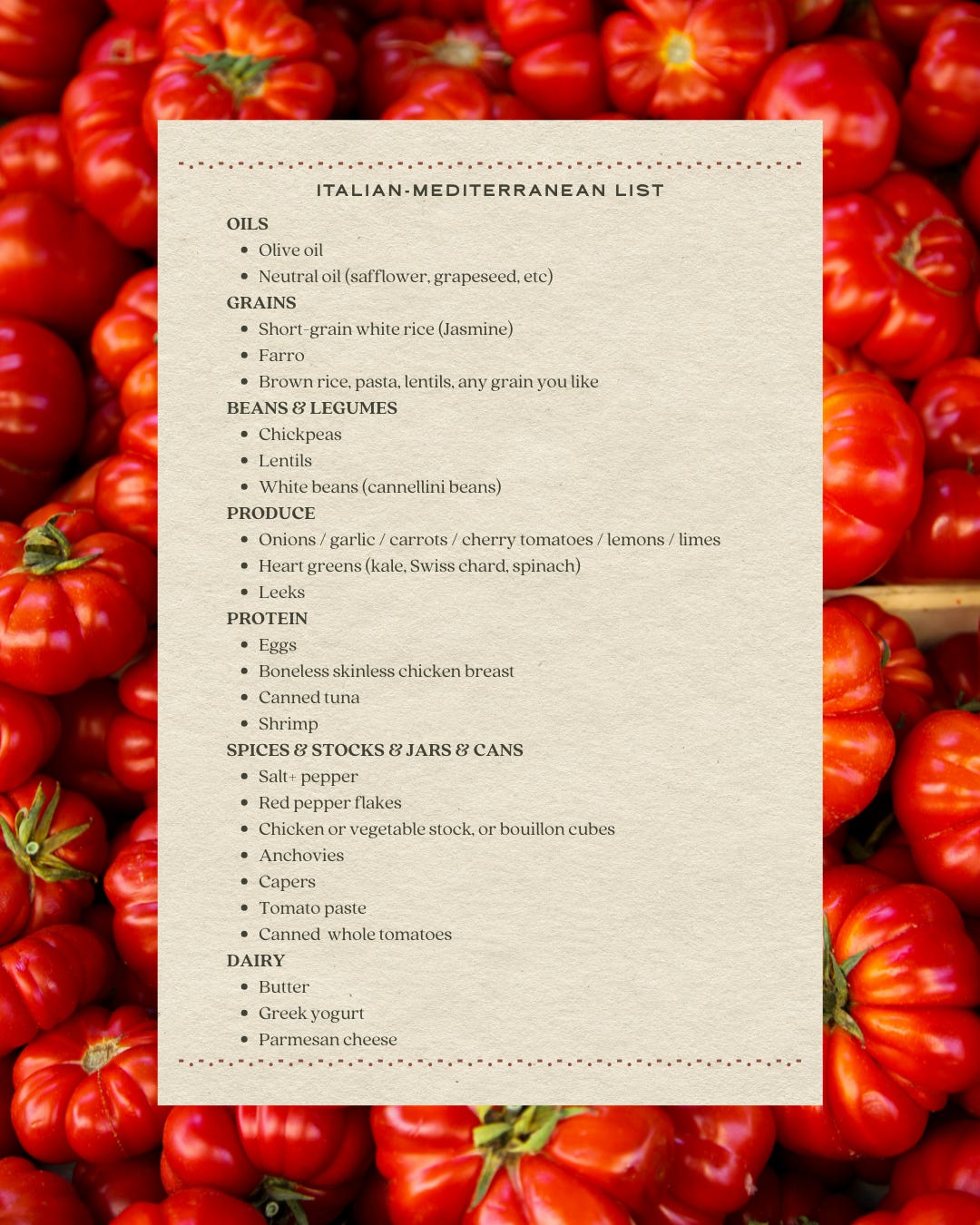
“Mediterranean” is an incredibly broad category of food, but here I’m talking tomato-heavy Italian dishes, lemony flavors, briny flavors (capers / olives / anchovies), legumes like chickpeas and lentils, and lots of fish and chicken.
Grains: Farro, brown rice. one long pasta (like spaghetti), one short pasta (like rigatoni, penne, or fusilli).
Beans and legumes: Chickpeas (I tend to use dried beans, but canned are honestly much easier), lentils, white beans.
Fruits and Vegetables: Cherry tomatoes, hearty greens (kale, Swiss chard, spinach), leeks.
Canned and jarred goods: Anchovies, whole tomatoes, capers, tomato paste, tuna.
Dairy: Greek yogurt, Parmesan or Pecorino cheese, fresh mozzarella if you’re feeling ambitious.
Freezer: A bag of frozen spinach.
Spices: Red pepper flakes.
Proteins: Eggs; chicken (skin-on thighs, skinless thighs, and/or boneless skinless breasts, which you can also freeeze); salmon; white fish like cod or halibut, shrimp.
Recipes:
Lemony egg soup with escarole. You can ignore the “escarole” part! Toss in whatever green you have, or don’t toss in a green. I make this soup all the time, especially when I am sick, and it is easy and hearty and tasty. If I have a chicken breast sitting around, I throw it in with the stock and the rice, then pull it out after 20 minutes, shred it with a fork, and stir the shredded chicken back in after I’ve added the lemon-egg mix.
Farro with tomatoes. I make this all the time at home, and I have never pre-soaked my farro. If I am feeling fancy, I get some fresh mozzarella put it on top.
Chicken soup with farro and greens. Totally fine to skip the fennel seeds here. The greens make it healthier and heartier, but if you don’t have them, this is still just a very nice recipe for a chicken-farro soup.
Chicken, leek, and rice soup. Very satisfying, very easy.
Garlicky chicken with lemon-anchovy sauce. This is a piccata-ish recipe without all the dredging-in-flour bullshit.
Spicy chicken piccata. A piccata recipe with no dredging. This one does call for pounding your chicken breasts flat but… I will admit I don’t do that, I just get some thin chicken breasts and go. I’ve also made this with swordfish, cod, and halibut — the fish kind of falls apart because it’s not dredged, and so it ends up being kind of ugly, but it tastes absolutely delicious. I’ll bet you could also do it with very thin pork cutlets.
Simple tomato sauce. Yes, you can buy canned tomato sauce, but it’s also very very very easy to make your own. This recipe is a great basic start. If you like a richer more wintery sauce with salty / unami flavors, throw in two or three anchovies (just trust me).
Simple spaghetti in fresh tomato sauce. This is my ultimate comfort pasta, and my hot tip is to skip all of the blanching and skin-removing and just use cherry tomatoes. Cut then in half. Put them cut-side-down in a hot skillet with the olive oil (here I also add roughly 6 cloves of sliced garlic) and let them cook for like… 7-10 minutes. Use a fork or the back of a slotted spoon to crush them (you do not need a “potato crusher”), and keep crushing / stirring for a few minutes until you have a sauce. Then let it simmer down its liquid, still crushing any chunky bits, while you boil heavily-salted water and cook your pasta until about halfway done. Finish the pasta in the sauce and add the butter / cheese as the recipe says. Basil is great if you have it! Also great without.
Pantry pasta with capers, anchovies, and garlic. Feeling ambitious / want to make this a little heartier and less pasta-only? Throw in a can of (rinsed) chickpeas — just cook ‘em a little bit in your garlicky olive oil, then put the cooked spaghetti right into the pan and stir it around.
Pasta e ceci. You can make this pasta and chickpea dish without the herbs if you don’t have them on-hand, and also without the greens if you don’t have them on hand, and it’s still delicious.
Chickpeas and burrata with lemon. I love burrata and would buy it just for this recipe, but you can also just make these creamy, lemony chickpeas and eat them.
Roasted eggplant with capers and garlic. Easy and healthy.
Red lentil soup. A warning that this does involve cumin, which is not on the above list. I don’t love cumin, so I sub in paprika or just use chili powder.
Tomato and cannellini bean salad. The simplest possible preparation. Adding a dash of sherry or balsamic vinegar ups the flavor.
Tuna, kale, and white bean salad. A very healthy meal that requires absolutely no cooking and about 45 seconds to prepare. Could not be easier.
Read Part Two, with East Asian, South Asian, and Mexican options, next.
xx Jill
Not the content I expect but …great tips. Maybe you need a cooking Substack too?