

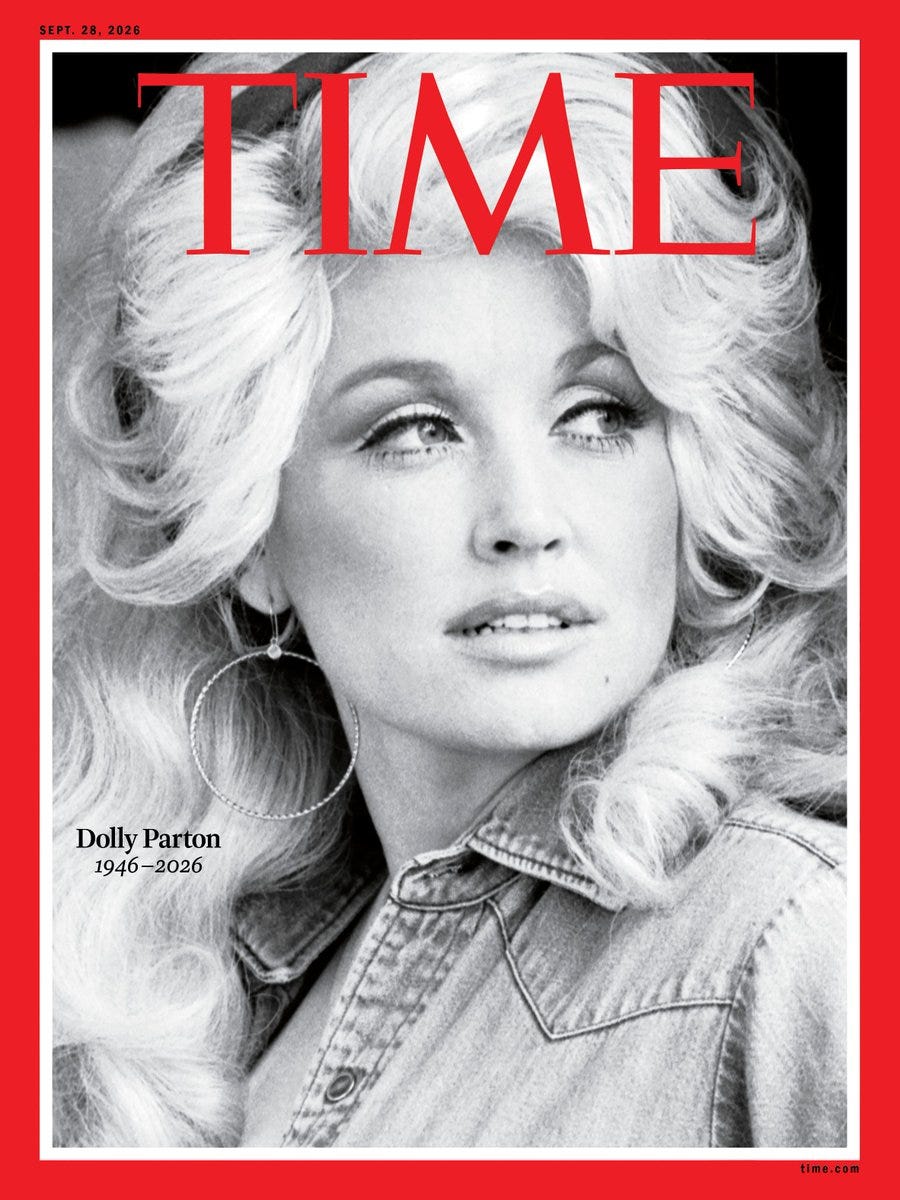
Dolly Parton, you have probably heard, died this week at 80. I am rarely affected by celebrity deaths, and yet I found myself crying in the kitchen this morning listening to “I Will Always Love You.”
I teared up again reading the lyrics to Coat of Many Colors:
My coat of many colors
That my momma made for me
Made only from rags
But I wore it so proudly
Although we had no money
I was rich as I could be
In my coat of many colors
My momma made for meSo with patches on my britches
And holes in both my shoes
In my coat of many colors
I hurried off to school
Just to find the others laughing
And making fun of me
In my coat of many colors
My momma made for meAnd oh, I couldn't understand it
For I felt I was rich
And I told 'em of the love
My momma sewed in every stitch
And I told 'em all the story
Momma told me while she sewed
And how my coat of many colors
Was worth more than all their clothes
What a woman. What a generational talent. What a loss. What a gift.
Dolly was a feminist icon, even if she rejected the term. She wrote and sang about women working pink-collar jobs all day just to line men’s pockets, about the judgment heaped on unmarried women who got pregnant and how none was laid at the feet of men who impregnated them, about the toughness and love of the Appalachian women she knew whose lives and stories were ignored or mocked by so much of society. She adopted the trappings of hyperfemininity, dressing in a way I can only describe as drag, and one got the feeling that she did it not because she thought it was the way all women should be but because she was, at her core, a performer, and this was her globally recognizable costume that she frankly thought was pretty fun to put on. Dolly was not standing next to Gloria Steinem demanding abortion on demand. But she was just as crucial a part of the broader feminist cause: A woman who made legible the lives and struggles of women most powerful people are happy to never consider, let alone empathize with.
I’ve been thinking about why Dolly’s death has been so deeply felt by so many, and I think it’s at least partly because she showed us how to live well. She clearly had fun being famous — she didn’t complain; she didn’t saddle herself with the obligation to be a spokesperson for one group or another.
She did strive for decency and humility. In 2018, an event she was a part of took some heat because it was called “Dixie Stampede;” Parton renamed it “Dolly Parton’s Stampede,” and explained to Billboard magazine: “When they said ‘Dixie’ was an offensive word, I thought, ‘Well, I don’t want to offend anybody. This is a business. We’ll just call it The Stampede,” she said. “As soon as you realise that [something] is a problem, you should fix it. Don’t be a dumbass. That’s where my heart is. I would never dream of hurting anybody on purpose.”
“Don’t be a dumbass” and “don’t hurt anyone on purpose” are pretty good rules to live by.
Dolly was generous. Her Imagination Library has sent more than 200 million books to children and babies around the world — 200 million. She spent millions helping disaster victims, giving to at-risk young people who graduated from high school, and funding hospitals and scientific research (she helped fund the Moderna Covid vaccine). She was a devout Christian and a devoted defender of LGBT rights.
The anecdotes going around about her on social media speak to this fundamental goodness:


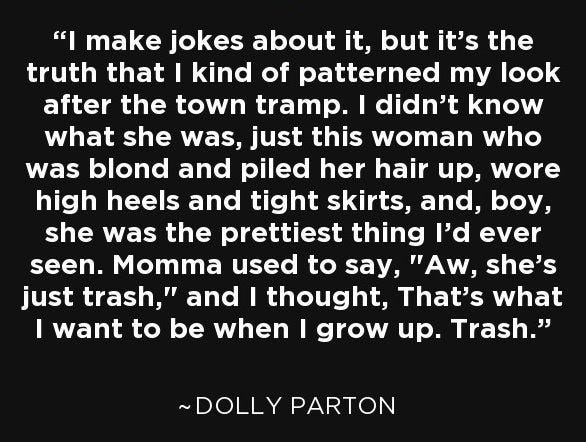
I hate the word “authentic,” but Dolly Parton was somehow intentionally one of the most artificial-looking women on the planet, and also one of the most authentically herself people in the world. She came from poverty and she embraced her background, forgoing not only shame, but any resentment. She embodied the women who are both envied and stigmatized, who provoke both desire and disgust:
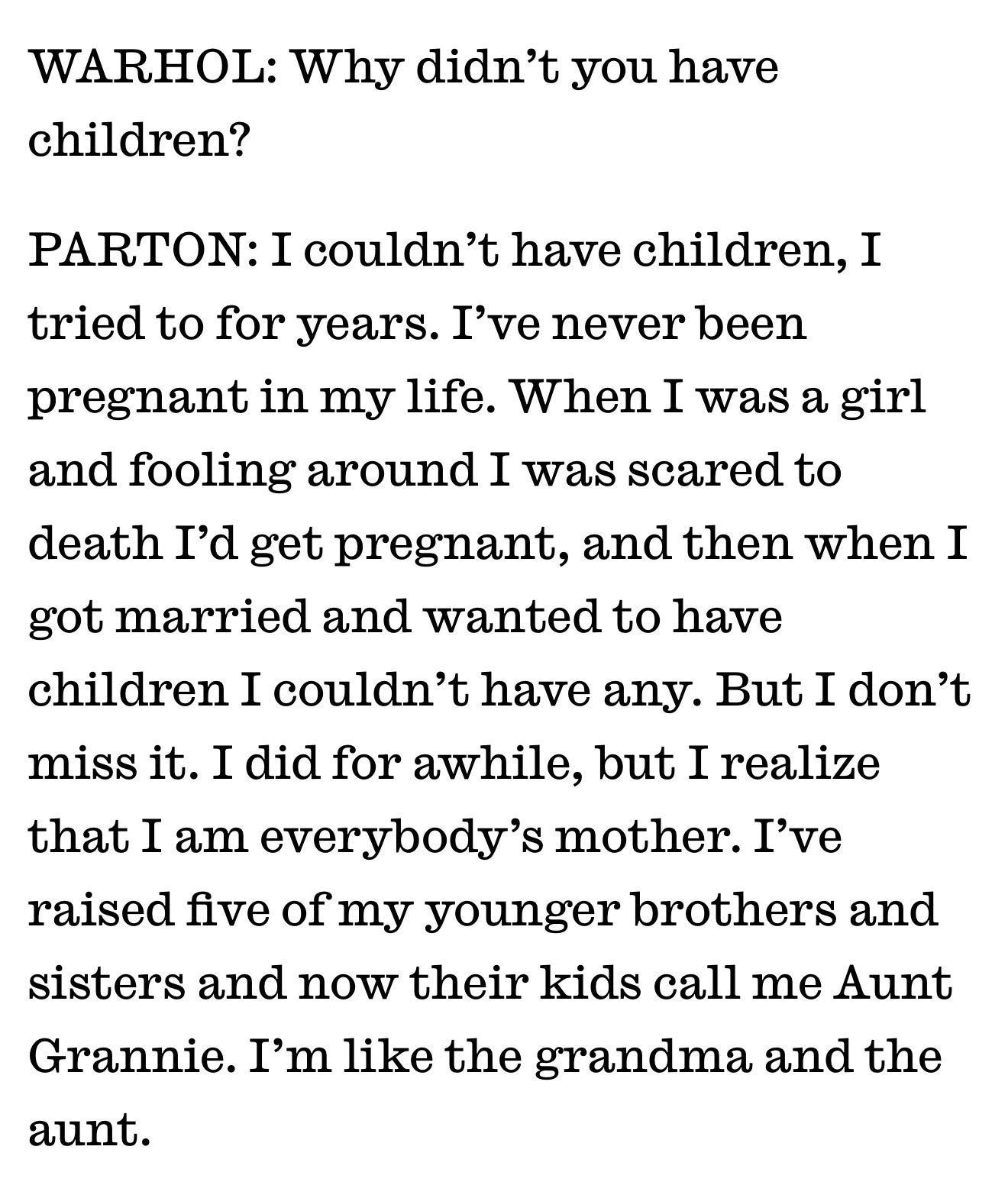
Her life was not just rags-to-riches (or “rags-to-rhinestones,” as the Times aptly put it). She struggled. She spoke frankly about being able to do all she did because she didn’t have children — that if she had been raising a family, she would not have had the time or energy for the tens of thousands of songs she wrote and the thousands of shows and events she performed at — but also of the grief of wanting children and not being able to have them. She held unmet desire alongside gratitude for what filled in that space.
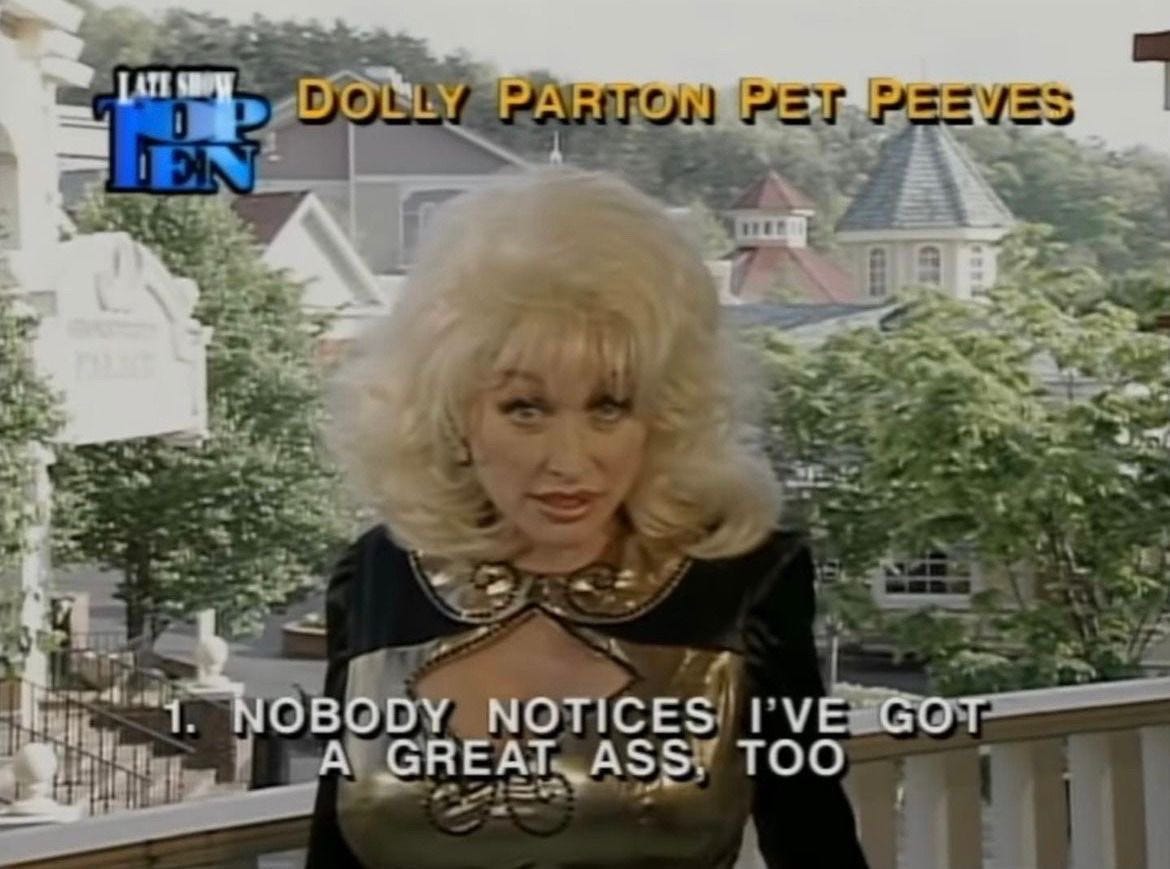
And she was funny as hell:
As is now so often the case when a celebrity dies, the worst people on the internet are plumbing her life for some evidence that she was “problematic” or even just kinda imperfect. I can pretty much promise that if Dolly was asked, she’d tell you she’s about as imperfect and problematic as any of us. Very few human beings contribute as much to this world as Dolly Parton did. She was not a perfect woman, but she was an extraordinary one. And we would probably all be better off if we emulated her humor, her humility, her decency, her generosity, and her insistence on taking responsibility for her own life — and having a lot of fun with it.
I have nothing particularly profound to add, except that like so many people around the world, I loved and admired Dolly Parton. I am sad she’s gone. I am glad she knew she was so widely beloved. I hope I can live even a little bit like her.
xx Jill