

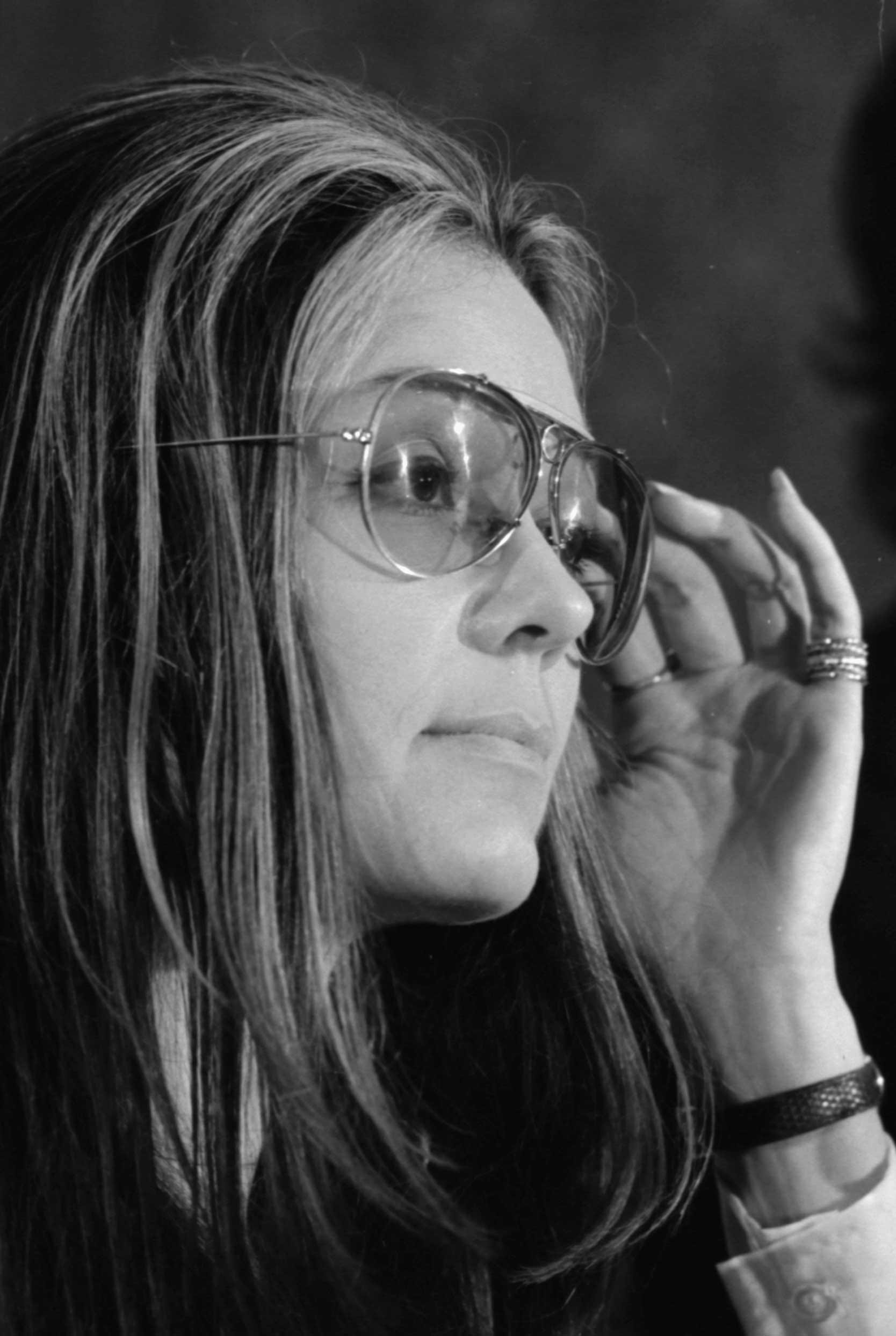
There are some people you just assume will live forever, and Gloria Steinem was one of them. She was larger than life, and she certainly lived a life that was larger than most. But she was not, alas, superhuman. And at 92, Gloria Steinem left the side of the living — and she left the world, and particularly the world’s women, infinitely better than she found them.
Steinem is most famous for her feminist activism, but she started out as a journalist. And so I’ll lead with her own words, the dedication to her 2022 memoir My Life on the Road:
HIS BOOK IS DEDICATED TO:
Dr. John Sharpe of London, who in 1957, a decade before physicians in England could legally perform an abortion for any reason other than the health of the woman, took the considerable risk of referring for an abortion a twenty-two-year-old American on her way to India.
Knowing only that she had broken an engagement at home to seek an unknown fate, he said, “You must promise me two things. First, you will not tell anyone my name. Second, you will do what you want to do with your life.”
Dear Dr. Sharpe, I believe you, who knew the law was unjust, would not mind if I say this so long after your death:
I’ve done the best I could with my life.
This book is for you.
It turns out that the best Gloria Steinem could do with her life was well beyond the highest capacity of most mere mortals. But that entreaty to “do what you want to do with your life” is one Steinem didn’t just follow; it’s one she made possible for millions and millions of other women.
I’m one of them. I have done what I wanted to do with my life. That would not have been possible without Steinem and the scores of other feminists who it is no exaggeration to say radically reshaped America and the world.
It was Steinem’s journalism that brought her to feminism. She covered an abortion speak-out in New York in 1969, where women stood up and one by one talked about the illegal abortions they had undergone — the danger and the humiliation, but also what it meant to not be forced into motherhood before they were ready, to not be tied to men they didn’t want to make lives with. Steinem had had this same experience: She broke off an engagement in her 20s so that she could travel the world, write, and report, but found out she was pregnant just as she was setting off on the rest of her life. She found a kind doctor in London, and he performed a safe but illegal procedure, and Steinem was off to India. Years later, back in New York, she was reporting on a group of women who recast abortion not as a shame she should carry in silence but a decision that made her a part of a club of women who, as Lindy West once put it, decided to steer the rudders of their own lives. This was revelatory. Steinem joined the movement she had been tasked with covering, and her natural charisma and intelligence quickly catapulted her toward its top.
I keep coming back to that moment in London, after she had left her engagement ring under her fiancé’s pillow and booked a flight to India, when she learned she was pregnant. Life is often a series of tiny but compounding decisions that can barely be called decisions, made without us really knowing we’re making them at all. But every once in a while, you really do face a Door 1 vs Door 2 situation, and once you walk through one, there is no going back. Gloria Steinem could have chosen Door 1, returning to her boyfriend, getting married, having a baby, and settling down into a life she did not want. Instead, she choose Door 2, which is why you’ve ever heard Gloria Steinem’s name at all.
When we talk about the right to choose — to end a pregnancy, or to continue one — these are the stakes. Not every woman is going to become Gloria Steinem. But Steinem’s death marks a moment to think of all of the women who didn’t have a Door 2 to walk through — women who wound up trapped in lives not of their own choosing. Think of all the talent, creativity, and innovation lost. The anti-abortion movement loves to play the could-have-been game: That pregnancy you aborted could have been Einstein! Or Beethoven! (Notice they never suggest it could have been Hitler or Kid Rock). What they don’t seem to consider, or simply don’t think is important, is all of the women forced into lives they did not want who could have been Gloria Steinem — or Nora Ephron, Billy Jean King, Gael Greene, Anaïs Nin, Nancy Grossman, Grace Paley, Anne Sexton, or Susan Sontag, all of whom signed onto Ms Magazine’s revelatory 1972 article “We Have Had Abortions.” Many of that article’s signatories went on to have children; some did not. But all were able to make their contributions — to social movements, to literature, to art, to film, to philosophy, to poetry, to their work, to their families, and on and on — because they were not forced into motherhood when they did not desire it or were not ready for it.
Think about who might be missing from public life because they didn’t have a choice. And it’s not just the women whose names you should have heard. It’s the scores of others who don’t need to be famous or successful to deserve the chance the shape their lives according to their own desires. That is fundamentally what the feminist movement, and the reproductive rights movement, fights for.
It is what Gloria dedicated her life to. And no, full liberation has not come. But we’ve gotten much closer to it because of her — even if her lifetime she also saw opponents of women’s rights succeed in rolling back some of her generation’s most important gains, including the right to abortion .
Much has been said and written about the complex and often terrible race and class politics of the second-wave feminist movement, and Steinem has sometimes become an avatar for a movement powered by a diversity of women but in which white upper-class women’s interests and experiences were prioritized and universalized to the detriment of the whole. Steinem, of course, was far from perfect. It seems worth saying, though, that many of her contemporaries of color defend her as a leading woman in the movement who tried to make sure that she stood in solidarity with women of color and tried to correct missteps rather than double down to defend them.
She also pushed to expand the second-wave feminist movement to pull in working-class women, women of color, lesbians, and other groups that were marginalized even with feminism itself. That work was vastly imperfect. But it never ceased.
Today, ask yourself: What have you and your loved ones been able to do thanks to Gloria and the other second wavers?
I write this newsletter to you now from Nairobi, Kenya, where I moved a few weeks ago after stints in Hanoi and Hong Kong. Any proceeds from it will go to a bank account in my own name, which has remained unchanged even though I am married. My child, who I had at 41 after much consideration, is deeply beloved and was enthusiastically welcomed after many years spent intentionally forgoing pregnancy and childbearing. I have a job I love, a partner I love, a child I love, a life that is so much better and more interesting than anything my younger self could have imaged. And had Gloria Steinem and the many, many other women who built out the second wave feminist movement not taken full advantage of the freedoms they had — not sometimes broken the law to live the lives they wanted — and then demanded more and more and more, well, I don’t think I would be sitting here right now. Because in truth, I’m not a Gloria Steinem. I am not particularly brave or uniquely adventurous or exceptionally talented. I might have kept the engagement ring on, slunk back to America, or never veered off of the easy path at all. And this, too, is the gift of Steinem and other women like her. Of course truly exceptional women were sometimes able to succeed in the pre-feminist days. But regular women? Those of us who were never going to be the best but still thought we deserved the same rights and opportunities as regular men? We wouldn’t have stood a chance.
Instead, whole worlds have opened up for us.
Not for every woman everywhere. But for many more of us. And those worlds keep opening. Because, as Gloria said, she had no plans to pass the torch to younger women — she planned to use her torch to light infinitely more.
There are, of course, the same opponents of women’s progress who want to slam doors in our faces, confine us, or obstruct our paths. Sometimes, they succeed. But the sweep of history is long. The world Gloria Steinem was born into in 1934 was vastly different than the one she left in 2026. And some of the biggest changes were brought about by Gloria Steinem herself. Her work, always, continues.
xx Jill
Brilliant! Great reflections and a timely reminder that we need to acknowledge & celebrate the women of the ‘second wave’, the Women’s Liberation Movement, as they changed everything. For all of us who follow in their wake. Yes, it wasn’t perfect - but hell, what is?! Or who is? Steinem and those countless feminists around her prized open debates that have changed the lives of all women & created opportunities that were hard to imagine back then in the ‘70s. All power to them. And those who continue that challenging work. You included Jill. 🙏
RIP, Gloria. Jill, thanks for breaking this story and sharing about Gloria's life. I am a happily divorced woman who was able to leave her abusive marriage because i had a good-paying job, was able to gave my own bank account, and because others before me helped normalize divorce. So thank you, Gloria, for opening that door for me and my child. Your life has been a blessing.