


Dear free subscribers,
I’ve unlocked this post for you to read in full as a thank-you for reading. This will give you a sense of what this newsletter offers to paid subscribers, and I’d invite you to upgrade if you want to read more work like this. Either way, I appreciate your attention and your support, and I hope you enjoy!
xx Jill
Few movements in American politics fascinate me more than MAHA. I’ve sometimes joked that I identify as MAHA-lite: I avoid ultraprocessed foods and plastics; you won’t find nonstick pans or black spatulas in my house; I think we should ban glyphosate, ban many food dyes, ban junk foods in schools and food advertising to children, and require food companies to prove their products are actually safe, similar to how the EU regulates food. I think the way Americans feed children in schools is a national shame. I think the way many of us feed ourselves and the children in our homes is a national shame.
I am also pro-vaccine, and utterly horrified by rising rates of measles and other preventable diseases. And as I’ve watched the rise of MAHA and seen many of my own long-held values go mainstream on the American right, I’ve wondered: Can the majority of the movement that just wants fairly common-sense changes to food and agricultural policies grab the MAHA mantle back from the anti-vaxxers? Or can the Democratic Party peel off what I would qualify as “reasonable MAHA” from the fringe forces that have disproportionate power within it?
I recently wrote a piece for Mother Jones about the gender politics of MAHA, which have taken shape as the movement made common cause with MAGA. The story is essentially this: MAHA has been a woman-led and woman-powered movement, but as it followed RFK Jr. over to Trumpworld, the men took over inside the White House. And as the men came into political power, they focused on more masculine-coded aims. Instead of taking on the top causes of the MAHA moms (food safety, pesticides, fighting Big Food and their ultraprocessed products), they’ve focused on things like changing the food pyramid to emphasize protein and diverting contraception funding to pay for testosterone therapy and treat erectile dysfunction. In the meantime, the Trump White House has been flat-out hostile to some of the MAHA women’s top priorities. Trump sided with the maker of the pesticide glyphosate in a Supreme Court case, and has ramped up domestic production of the poison. He has made it easier for Big Food and Big Ag to operate without oversight or consequence for decisions that harm humans and the environments in which we live.
In reporting the piece, I read a lot of MAHA voter polls, and talked to several MAHA leaders and adherents. And what I noticed — and what’s clear in the polling data — is that hostility to vaccines is not actually a top MAHA issue. That isn’t to say that many MAHA people aren’t also vaccine opponents; a sizeable minority obviously are. And many more MAHA adherents basically keep their vaccine opinions to themselves or fall back on the language of “choice,” happy to accommodate the anti-vax among them. But I think it’s a mistake for Democrats, and the broader left, to write off MAHA voters as reactionary anti-science dummies; it’s even worse to negatively polarize ourselves into opposing the MAHA views that aren’t so different from what you might have heard from 2012 Michelle Obama.
Here’s a good example of what MAHA priorities actually look like, from Politico (dark purple is “core view,” light purple is “not a core view”):
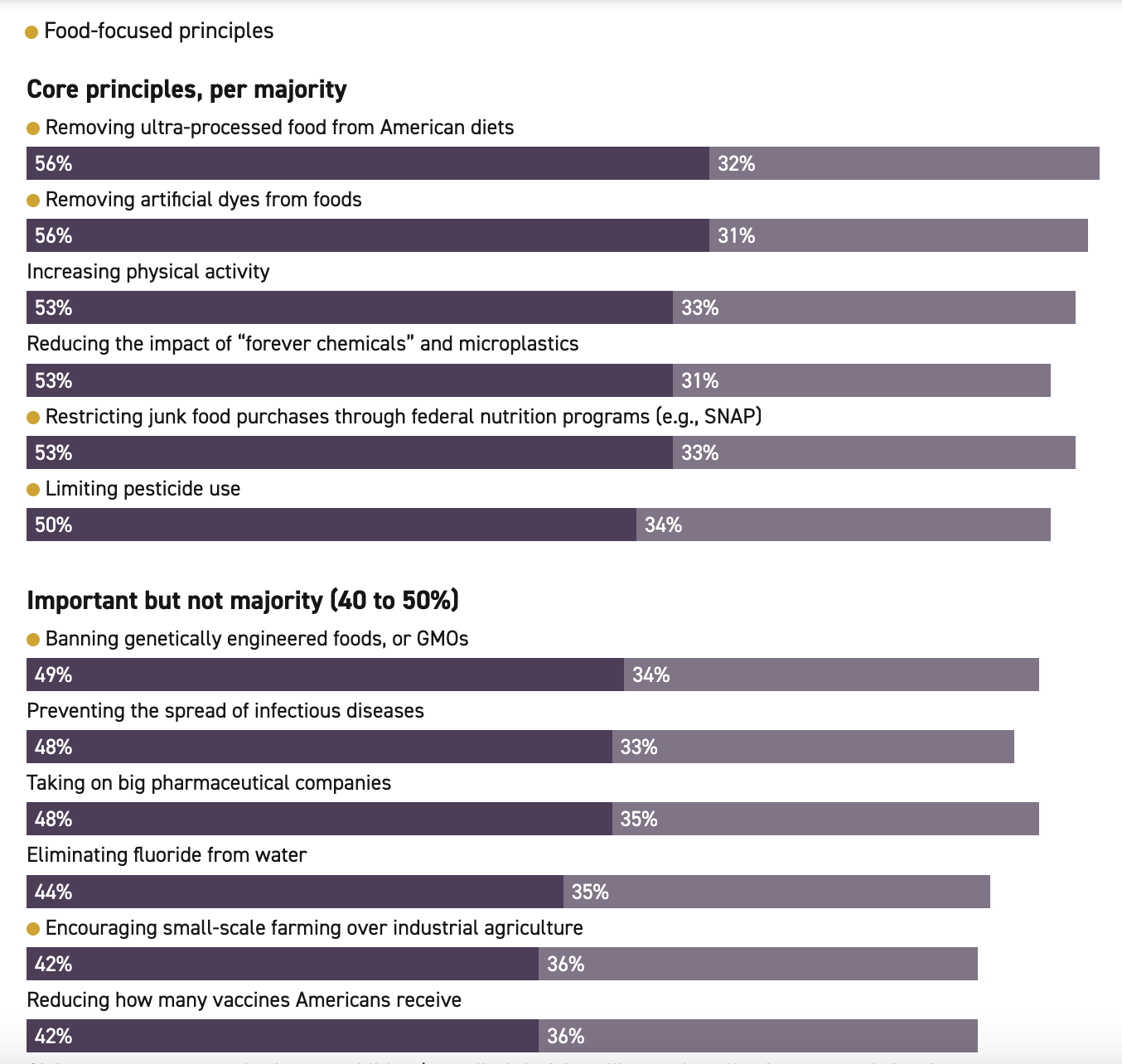
I’ve been asked whether I think the MAHA movement has done more good or more harm, and that’s a tough question to answer. The anti-vax component of the movement has objectively done more harm, and I’m not sure it’s done any good at all. But MAHA more broadly has brought the virtues of healthy eating and physical movement back into the conservative sphere, breaking the bizarre political polarization over health. When Michelle Obama fed vegetables to schoolchildren and encouraged them to exercise, conservatives went nuts — you will pry my child’s tater tots out of their cold dead hands. Now many Republicans are pushing a back-to-basics view of food. It’s not exactly Michael Pollan — the right-wing nutritional philosophy is masculine-coded by way of maximal protein, not “eat food, not too much, mostly plants” — but it’s definitely better than insisting that ultraprocessed foods and Type 2 diabetes are as American as McDonald’s deep fried apple pie.
MAHA voters are also disproportionately young, female, and politically disengaged. These are gettable voters for Democrats. And a lot of existing Democrats would be thrilled to see the party take on Big Food and Big Ag, and to see progressive leaders insist that Americans deserve healthier, safer foods on our grocery store shelves and in our schools. I would certainly be thrilled to see the broader left talking about holistic health, and understanding that how we eat and how we move shape how well we are — and that healthcare should of course treat disease, including with pharmaceuticals (many of which are nothing short of miracles), but that a health system reliant on identifying symptoms and then whack-a-moling them with drugs is missing a big part of what “health” means. Now that MAHA has broken through on the right, a lot of this will sound like common sense, not left-wing elitism from oat-milk-latte drinkers packing heirloom tomatoes into their New Yorker bags at the farmer’s market. That’s a good thing.
But the one component of MAHA that will absolutely not fly with Democrats is the anti-vaccine stance. So one question is: Can Democrats have MAHA without the anti-vaxxers?
And: How did the anti-vax movement and the MAHA movement become so intertwined in the first place?
And finally: How and why did the Democratic Party move away from its stance against ultraprocessed food, against Big Food and Big Industry, and away, even, from the scientific consensus on food and health?
I have my theories.
The first thing to understand about MAHA is that it’s a pretty ideologically diverse movement, and most of its adherents don’t actually prioritize the anti-vax stuff. But I suspect anti-vax sentiment has grown within MAHA in part because the more reasonable aspects of the MAHA ideology have been sidelined in mainstream American politics. As someone whose frustrations around the American and global food systems became even more acute after having a child, I can understand how this works. I spent my pregnancy and my child’s first year in Hong Kong, where the nutritionist at my doctor’s office told the pregnant women that we should avoid meat from the US and from China, instead buying what was imported from the EU, Australia, New Zealand, and Japan; we should also consider buying fruits and vegetables from the same countries, given the pesticides used in the US, China, and much of Southeast Asia. When my child began eating solids, I made all of his food, but would occasionally browse the baby food section of the grocery store, and noticed that it was virtually impossible to get anything that wasn’t sweetened — the packaged food all had sweet fruits in it, and even things like rice cracker snacks were mango- and strawberry-flavored, and full of hidden sugars and mysterious additives (when everything for babies is artificially sweetened, why are we surprised when toddlers refuse to eat anything that isn’t either totally bland or totally sweet?). When we moved to Hanoi, imported foods were harder to find, and I felt constantly stressed about what in the world was going on and into the meat, fruits, and vegetables produced en masse to feed a country of millions — a spectacular achievement, but also one that seemed to coincide with increasing rates of many health problems, in a country where transparency is not exactly something the government provides. I couldn’t take my child outside for much of the year because of severe air pollution.
I now live in Kenya, where organic food grown on local farms is plentiful, but I have to tote liters of milk with me when I travel domestically, because there’s only one brand of milk here that reliably tests for aflatoxin (a cancer-causing toxin that causes liver damage and other conditions, especially in children), and it’s not readily available outside of Nairobi. When it comes to how we eat, “safe” doesn’t just mean free of pesticides that have been linked to cancers and free of hormones that turn pigs and chickens into Franken-stock that cannot physically function during their short lives. It also means robust detection systems for food-borne illnesses and measures like pasteurization and testing to counter natural processes that can make humans really sick.
I largely rejected ultraprocessed foods before having a child, but raising and feeding one has brought into sharper focus just how much time, effort, money, and research it takes to ensure that a small person is eating well without exposing their small systems to dangerous pesticides, under-tested dyes, and even known toxins. And still, there is so much individuals cannot control, no matter how hard we try.
And for much of this I looked at people around me and felt like an insane person.
In Hanoi, most other people I met — including resourced and educated ones — shrugged off the pollution and ate whatever. In Hong Kong, I asked a moms WhatsApp group about how they were dealing with the fact that the local parks coated the grass in pesticides, and they collectively shrugged — their six-month-olds crawling on it and sticking it in their mouths just didn’t seem like a big deal. In the US, I’ve seen chicken breasts the size of footballs on grocery store shelves, carts packed brightly-colored cereal with more sugar than your average wedding cake, Pepsi in school vending machines, and far too many children who do not seem to be being particularly well-served by having nearly unlimited access to all kinds of highly-processed and sugar-laden foods.
When you look around and think something is wrong here but you’re the odd woman out, one place you can usually find like-minded people is online. And I suspect that’s what happened to a lot of the MAHA moms: That in pursuit of information and community about fair anodyne views (pesticides and ultra-processed food bad, clean air and exercise good), they got sucked down some dark rabbit holes. When you look at the world around you and see what are obvious health failures and perils, but the people in charge of health don’t seem to notice (our pediatrician certainly never brought up air pollution or pesticides) and the people in charge of politics either don’t seem to care or are actively supporting the big industries that compromise our health, well — you start to place more trust in the people who also reject what is obviously bad. When you live in a society that feeds children ultra-processed high-calorie low-nutrition high-sugar food at schools with no recess and then solves the predictable problems by prescribing Ritalin to kindergarteners and Ozempic to fourth-graders, it gets easier to conclude that maybe society — and the public health officials and doctors who have authority in it — is not to be totally trusted. And when the people you’ve found online who share your same fairly common-sense views begin adding to your anxiety-addled list of dangers, and vaccines are on that list, you might ask yourself: Do they have a point?
To be (again) clear, I am not anti-vaccine (I am very pro-vaccine, in fact, give me all of them). I am not anti-pharmaceutical — I think GLP-1s are miracle drugs, and while the research on ADHD is more mixed, there’s no question meds can be helpful for some people. But I can also understand how the MAHA moms get to a point of such total distain toward mainstream medicine and standard American approach to food, health, and medicine. And I can see how that sense of alienation puts some of them on the highway to crazytown.
Part of the problem is that Democrats haven’t given them anywhere else to go.
Once upon a time, opposition to Big Food and Big Ag were progressive issues. And this makes sense: We were the side of science, of skepticism of corporate power, of children’s rights, of health. But with a handful of important and growing exceptions, Democrats have backed away from these issues. I think part of this relates to the utter shitstorm that hit Michelle Obama with her Let’s Move! campaign, her White House vegetable garden, and her efforts to give schoolchildren something other than ketchup as a vegetable. Part of it relates to the rise of Donald Trump, and the feeling that Democrats were losing because they were seen as the party of out-of-touch elites, with healthy eating coded as elitist.
But I think a part of it also has to do with shifts in broader progressive discourse around food and body size.
The 2010s brought the rise of the fat acceptance movement, which made a series of important cultural gains. Skinny was not the only way to be beautiful. Thin did not immediately equal healthy, and fat did not immediately equal unhealthy. The relationship between health and body size is complex. Larger people face all kinds of discrimination, including by doctors who attribute all problems to their weight and leave them sick and suffering. These are all important takeaways, and I think Americans have a more sophisticated understanding of them than ever before.
But among some subcultures — and I would say particularly among the young, progressive, empathetic, and politically-engaged people who made up much of Woke 1 — the message became that there was no relationship between weight and health, or perhaps that trying to be “healthy” was itself fatphobic and ableist (I wish I was making this up but I am not). This was not a majority view. But it also wasn’t entirely marginal. The idea that one could engage in health-seeking behaviors at every size, that BMI gives us very limited information on any specific individual, and that weight loss was not as simple as calories in calories out morphed into one that said that “obese” was a slur, BMI was entirely meaningless, giving your children anything but full access to any food they wanted was eating disorder culture, and one’s weight had virtually nothing to do with how one ate or moved. Perhaps most dangerous was the idea that weight, and even being significantly overweight, had no bearing on a person’s health. I suspect that a lot of young Democratic staffers — the people who for better or worse shape the priorities and language of our electeds — either held these views or were too afraid of being bullied by their compatriots to say otherwise. That shaped how Democrats talked (or, more accurately, didn’t talk) about food and health — it all became too fraught. Even Michelle Obama was tarred as fatphobic for wanting kids to exercise. These positions ceded left-wing authority on health and science (the link between obesity and a series of health issues is well-established, but many progressives denied it exists). And we left a lane of obvious and popular political thought wide open.
The MAHA movement filled it.
The Democratic Party is not going to attract voters who love MAGA and hate vaccines. Part of the rise of the anti-vax movement has nothing to do with MAHA, and is all about Covid and the political polarization the pandemic wrought. Refusing the Covid vaccine became a right-wing political and cultural marker, and led some of those reactionaries to broader anti-vaccine views; they have then made common cause with MAHA under the broader MAGA umbrella. But that marriage is not necessarily a happy one.
I do not think Democrats have done the party, or the public, any favors by rejecting the science on food and nutrition, and or by doing the bidding of the food industry under the guise of progressive ideals. We are, luckily, in an interesting political moment in which many left-of-center voters seem hungry for a return to common sense — a move away from MAGA corruption, insanity, idiocy, and bigotry, but also from the progressive platitudes that too often obscured rational thought. Ozempic has largely undermined efforts to replace scientific consensus with ideological conclusions about food, weight, disease, and health. GLP-1s, along with MAHA, pose real threats to Big Food, and the food and agricultural industries are scrambling to keep Americans eating what they produce.
By mocking and rejecting MAHA, Democrats miss opportunities not just to capture wider support, but to appeal to their own voters and to carry out their mission to make Americans’ lives better and healthier. There are scores of MAHA-lite voters out there who are pro-vax, pro-environment, and anti-Franken-food. Left-wing voters and commentators should forgo any fears of being labeled MAHA and instead take up the mantle of the people who actually want to make America healthy. And Democrats should give MAHA’s more reasonable majority a reason to turn out for them.
xx Jill