


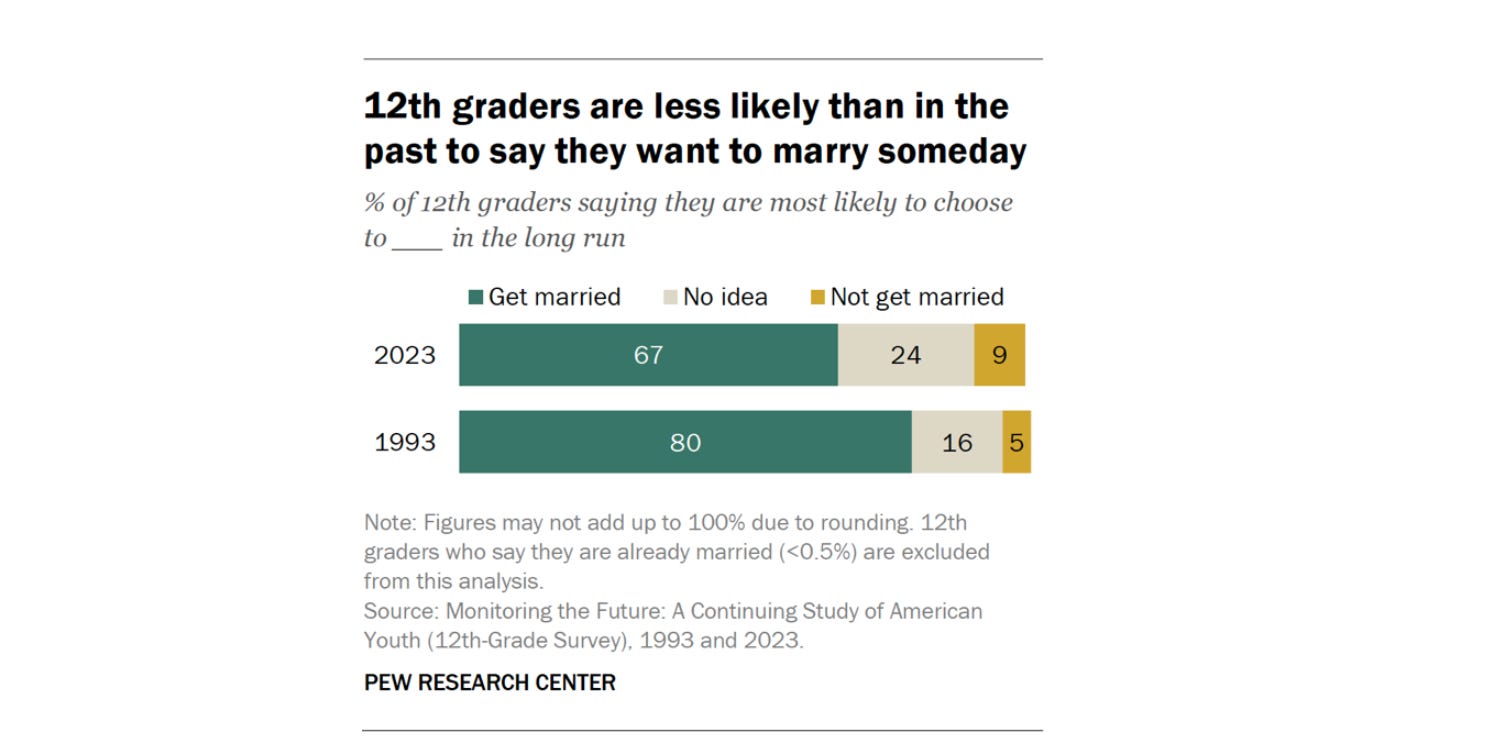
New research from Pew shows that high schoolers, and especially high school girls, are less likely than ever to say that they want to get married someday. In 1993, 80% of high schooler seniors said they’d like to marry, while 5% said they didn’t plan on marrying and 16% said they weren’t sure. Now, 67% say they want to marry — still two-thirds of them — while 9% say no marriage and almost a quarter say they’re unsure:
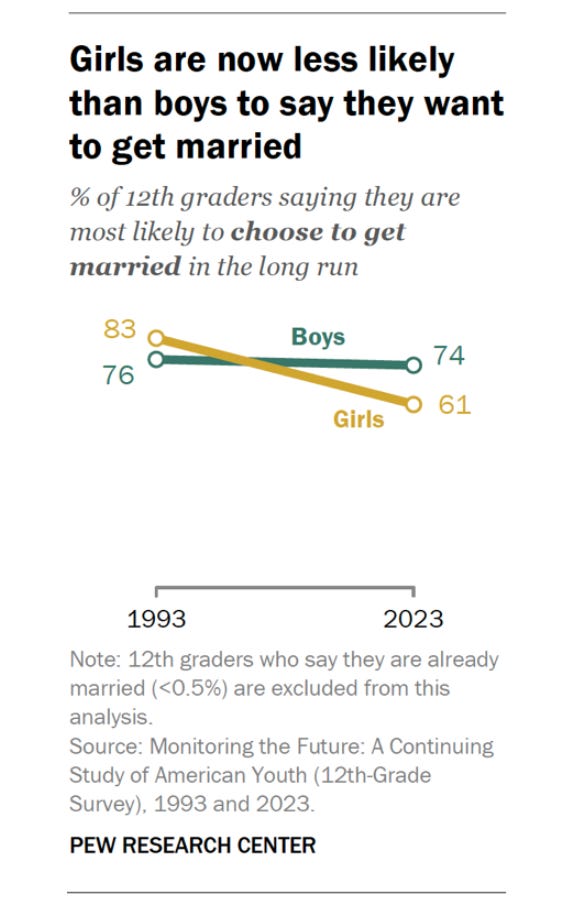
What’s grabbed headlines, though, is that the decline has been fueled almost entirely by high school girls. While boys have stayed fairly stable in how many of them say they want to marry, girls have gone from overwhelmingly wanting marriage to being even less likely than boys to want to wed:
Conservative groups and writers have met this new survey with some panic. If 12th graders don’t want to get married, I guess the logic goes, then they won’t get married, and America’s declining rates of marriage and childbearing will continue and will eventually destroy society. To them, this new survey indicates a broader social shift away from marriage and childbearing, which is bad, because in their view, the nuclear family is the good and necessary backbone of any moral and functional culture.
But actually, it’s great that far fewer high school girls are even thinking about marriage.
It’s telling that the girls who no longer say marriage is on their minds largely aren’t saying that they don’t want to get married; instead, they’re saying that they have no idea. And good! These are girls who are 16, 17, and 18. The average age of first marriage for American women is now nearly 29, with women who graduate from college marrying even later. Marriage, for the vast majority of high school girls, is many years away — if it happens at all. At 17, they should be thinking about their friends, the guy or girl they like, what they’re getting up to this weekend, how they’re going to complete their homework when they also have a big soccer game, and what happens after graduation. Thinking about marriage is a distraction at best.
Conservatives are right, though, that this does signal a cultural shift. One of the biggest changes American feminists wrought was the end of marriage as almost entirely compulsory for women in nearly every corner of the nation. In 1949, nearly 80% of households were headed by married couples, which is a wild statistic when you think about it: It means that marriages had to happen quite young, that very few young people lived alone. And indeed that’s exactly what happened.
Marriage rates now are lower because, yes, a higher number of people are staying unmarried for their entire lives, but also because people are marrying later and spending many more years living independently. In the early 1950s, the average woman was barely out of high school when she married, and a great many were marrying as teenagers. The teen birthrate peaked in the US in this same period. And people were dying earlier, too. In 1949, life expectancy at birth was 65 for men and 70 for women; now it’s nearly 76 for men and 81 for women, meaning that Americans have added more than a decade on average to our lives. We may be marrying and reproducing later, and pushing back a whole series of other markers once indicative of adulthood, but adult life is also literally a lot longer.
Most importantly, when it comes to being seen as adults, living a socially acceptable life, and finding a sense of purpose, women simply have many other options now.
Teenage boys have been telling researchers that they want to marry at roughly the same rates for the last 20-plus years. Most of them say they want to marry someday; some of them don’t; many say they just aren’t thinking about it. And there has been absolutely zero moral panic over the fact that until recently, more girls than boys wanted to marry. Which suggests to me that this is less about concern over young peoples’ marital aspirations and more about concern that women are not doing what is presumed to be their duty: Civilizing men by marrying them, and then dedicating their lives to their husbands and children.
It is interesting to ask why we’ve seen such shifts from girls but not boys, and I think the answer is pretty obvious: Life has changed much more for girls and women than it has for boys men.
